 Office info
 Storage info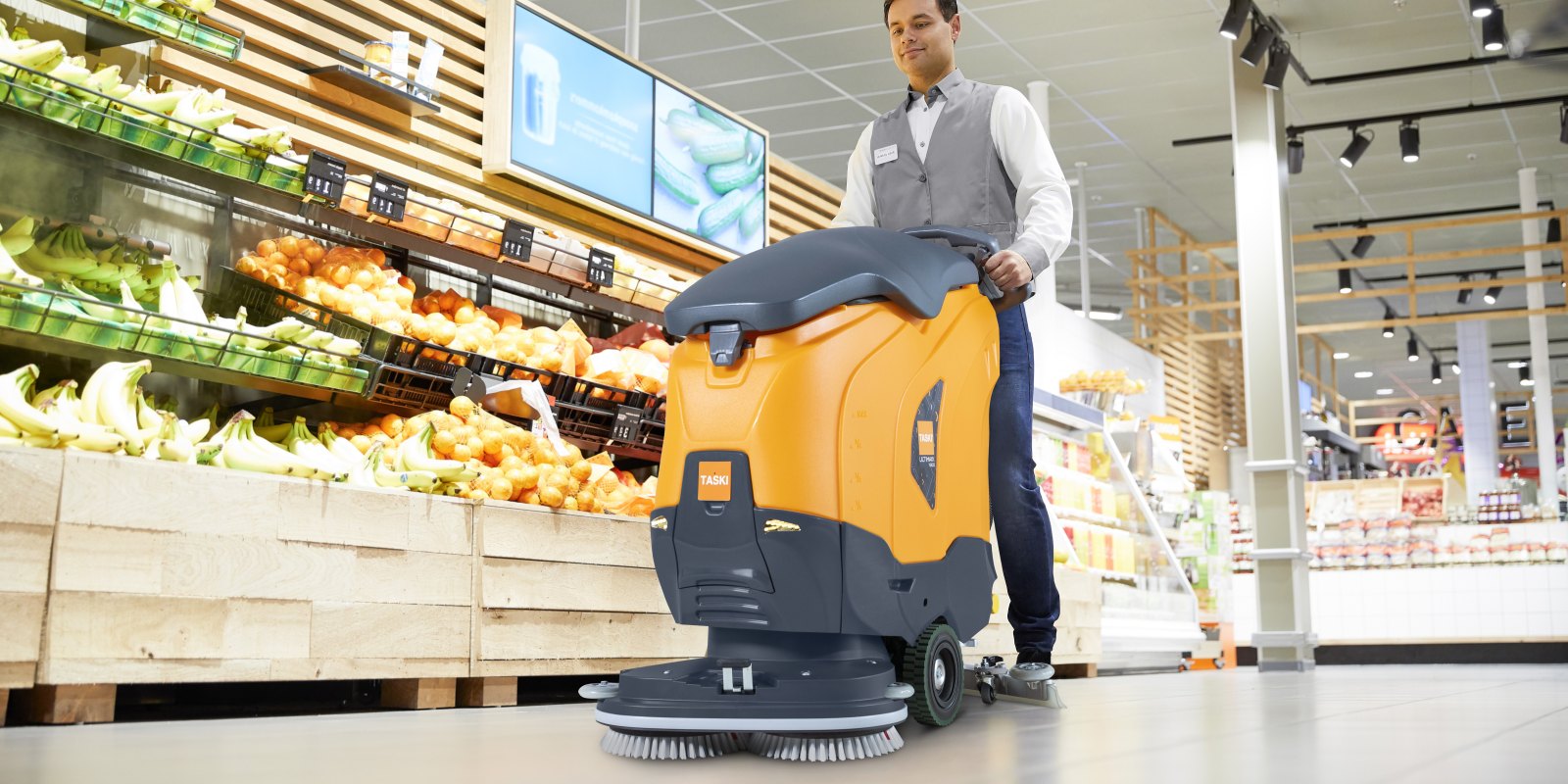
In short
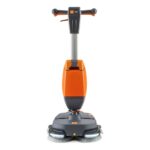
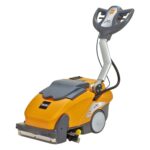
- For washrooms, kitchens and areas up to about 300 m², choose a compact machine with twin brushes or Twister pads (TASKI ULTIMAXX 360).
- For corridors, lobbies and retail floors from 300 to 2,500 m², choose a walk-behind machine with a 43–65 cm working width (ULTIMAXX 900 or 1900).
- Above 2,500 m² a day, a machine with wheel drive pays off (ULTIMAXX 2900 Performance); above 5,000 m², a ride-on (swingo 2100µicro, XP-R).
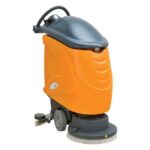
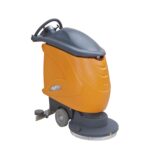
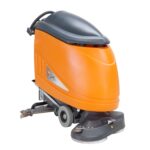
- The earlier swingo range (350B, 455 B, 755B, 855 B, 1650) remains available as an alternative, and we keep service and spare parts for it.
A mop and bucket are enough for a small office. Once the floor exceeds a few hundred square metres a day, a scrubber-drier does the same job three to five times faster, leaves the floor dry immediately behind it and uses less water and chemistry. The question is not whether you need a machine, but which one — and the answer depends on four things: the area, the floor, the people who will operate it and the space it has to move through.
Today’s main TASKI models are the ULTIMAXX range (360, 900, 1900 and 2900): modular machines whose working width, brush deck and battery are chosen to suit the building. The swingo range, which many customers already own, is still available and appears in the table as the alternative.
1. How much floor do you clean every day?
The first question we ask a customer is not “which model” but “how many square metres a day and in how many hours”. A machine’s theoretical performance (m²/h) says how much floor it can scrub under ideal conditions; in practice count on 60–70 % of that figure because of turning, refilling and obstacles. The number in an ULTIMAXX model name (900, 1900, 2900) is the reach in m² per tank fill, so it tells you straight away how much can be scrubbed without refilling.
| Daily area | Machine class | Recommended model (ULTIMAXX) | Working width / performance / tank | Alternative (swingo) |
|---|---|---|---|---|
| up to 300 m² washrooms, kitchens, narrow passages | Compact, twin brushes or Twister pads | ULTIMAXX 360 | 49 cm / 1,470 m²/h, 4 l tank (up to 600 m² per fill), Li-Ion up to 2.5 h | swingo 350B |
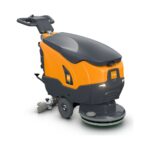
| 300 – 1,000 m² smaller hotels, restaurants, schools | Compact walk-behind | ULTIMAXX 900 | 43–55 cm / 1,290–1,650 m²/h, 20 l tank (900 m² per fill) | swingo 455 B |
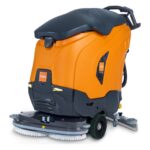
| 1,000 – 2,500 m² hotel lobbies and corridors, supermarkets, hospitals | Walk-behind, larger tank | ULTIMAXX 1900 (Economy) | 43–65 cm / 1,290–2,925 m²/h, 43 l tank (1,900 m² per fill), 60 dB(A) in Eco mode | swingo 755B · swingo 855 B Power |
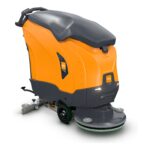
| 2,500 – 5,000 m² large buildings, car parks, halls | Walk-behind with wheel drive | ULTIMAXX 2900 Performance | 50–65 cm / 2,250–2,925 m²/h, 63 l tank (2,900 m² per fill), drive 4.5 km/h | swingo 1650 |
| over 5,000 m² shopping centres, logistics, airports | Ride-on / stand-on | swingo 2100µicro · swingo XP-R | 55–75 cm / 3,025–4,500 m²/h, 75 l tank | — |
A 100-room hotel usually has 1,500–2,500 m² of public areas (lobby, corridors, restaurant, spa). There the ULTIMAXX 1900 is the best choice: its 43 l tank covers up to 1,900 m² without refilling, and in Eco mode it runs at 60 dB(A), so corridors can be scrubbed while guests are in the hotel. If you already own a swingo 755B or 855 B, they do the same job with a smaller tank (40 l) and remain a good choice for that area.
2. What is the floor and what is the dirt?
Ceramic, stone, epoxy, PVC and wooden floors do not call for the same machine. Smooth, level floors (lobbies, corridors) are best scrubbed with a disc brush or pad — even pressure, quiet, suitable for daytime work. Textured tiles with deep grout lines, greasy kitchens and areas along walls are better cleaned with a cylindrical brush, which scrubs at 800 rpm and more and reaches into joints and corners. The advantage of the ULTIMAXX range is that the brush deck is a choice: the same 900 or 1900 machine can run a single disc, twin discs or cylindrical brushes, depending on the floor.
- Daily maintenance of smooth floors: disc machine with a pad and a neutral cleaner (TASKI Jontec 300).
- Greasy kitchens and washrooms: ULTIMAXX 360 with twin brushes or ULTIMAXX 900 with cylindrical brushes (45 cm) and an alkaline cleaner.
- Polishing and deep cleaning without chemicals: the ULTIMAXX 360 and 1900 have a Twister button that switches the machine to work with Twister diamond pads.
- Stripping and crystallisation: a single-disc machine — ergodisc omni (900 rpm) or ergodisc HD for heavy work.
- Carpets: a separate programme — carpet extractors and TASKI Tapi chemistry, not a scrubber-drier.
3. Who will operate the machine?
A machine the staff do not like ends up in the store room. So when choosing, pay attention to three things that rarely appear in the data sheet:
- Training. The TASKI control panel uses icons instead of text, and all daily maintenance points are marked in yellow and come off without tools. The ULTIMAXX 1900 and 2900 have an IntelliTouch screen with an interactive guide, and the IntelliKey NFC key opens each operator only the programmes they are allowed to use. Training takes an hour, not a day.
- Ergonomics. An adjustable, folding handle, foot-operated brush and squeegee lowering (swingo 755B), wheel drive on the heavier models (ULTIMAXX 1900 Performance and 2900, swingo 855 B and 1650). Above 5,000 m², a ride-on machine reduces fatigue and halves the time.
- Noise. Below 65 dB(A) means you can scrub the lobby while guests are present. The ULTIMAXX 900, 1900 and 2900 with Whisper technology run at 60 dB(A) in Eco mode; the swingo 755B and 1650 are in that class too.
4. Where will the machine move and where will it park?
Measure the narrowest doors, the lift width and the ramps before choosing a model. All walk-behind machines up to a 55 cm working width pass through standard 70–80 cm doors; the ULTIMAXX 1900 and 2900 with a 65 cm deck need a wider passage, so check that choice on site. The ride-on swingo 2100µicro is designed to fit most standard lifts. Also check where the machine will charge — it needs a dry spot with a socket and a drain for emptying the tank.
Gel or Li-Ion battery?
All ULTIMAXX machines and the BMS versions of the swingo have a built-in charger that prevents deep discharge — the machine charges from a wall socket, with no external equipment. Gel batteries are cheaper and sufficient for one shift a day (the ULTIMAXX 900 runs up to 2.5 h in Eco mode). Li-Ion batteries charge faster, allow short top-ups during breaks and last more cycles, so they pay off for two-shift work or when several buildings share one machine. The ULTIMAXX 360 comes only with a Li-Ion battery: up to 2.5 h of work with 1 h of charging.
Used TASKI machines from classified ads often come without batteries, without a service history and with worn squeegee blades. Before buying, ask for the hour-meter reading, test the vacuum on a wet floor and check the availability of spare parts. Interesta services both new and used TASKI machines in Montenegro, the ULTIMAXX and the swingo range alike, and keeps blades, brushes, pads and batteries in stock.
What goes with the machine
The machine is a third of the solution. The result on the floor also depends on the chemistry and the accessories:
- Chemistry: the TASKI Jontec programme for daily scrubbing, stripping and coating; dose as instructed, never by eye. The ULTIMAXX 900, 1900 and 2900 can be fitted with the IntelliDose+ system, which doses concentrate into the tank automatically.
- Brushes and pads: the pad colour sets the aggressiveness — white and red for maintenance, green and black for deep cleaning and stripping; Twister diamond pads for chemical-free polishing.
- Cleaning plan: who, when, with which product and for how long. We draw it up together with you at delivery.
- Service: an annual inspection, squeegee blade replacement and battery checks extend the machine’s life to 8–10 years.
Send us the floor area, the floor type and the number of cleaning hours a day, and we will propose two or three models with prices and a maintenance plan. You can also trial the machine in your own building before deciding.