 Office info
 Storage info
In short
- The washing result and the cost per kilogram of linen are decided not by the detergent but by the dose: the same chemistry dosed “by eye” gives grey towels and a bill twice as high.
- Manual dosing makes sense up to two or three machines: powder, tablets or paste, a measuring cup and a wall chart per kilogram of dry linen.
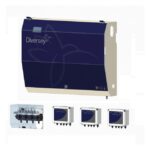
- From three machines or 300 kg a day, automatic dosing of liquid chemistry pays off: Diversey DF10M MK2 (up to 8 machines) or DF20L (up to 10 machines) with the CLAX liquid range.
- An automatic system doses to the millilitre, stores up to 99 formulas and sends consumption to the cloud, so chemical use is visible per machine and per programme.
In a laundry the most money is wasted not on detergent but on the wrong amount of detergent. Too much leaves an alkaline residue that irritates the guest’s skin and shortens the life of the linen; too little leaves grease and greying, so the linen is washed again. The question every hotel and laundry asks us is: manual or automatic dosing? The answer depends on the number of machines, the kilograms per day and who is standing next to the machine. In this guide we present both systems with real dosing figures from the technical data sheets of the Diversey CLAX range.
Why the dose matters more than the detergent
Every professional detergent is dosed per kilogram of dry linen, within a range that depends on water hardness and soiling. For CLAX 100 that range is 1.5 to 12 ml/kg; for CLAX Build it is 4 to 28 ml/kg. The difference between the lower and upper limit is sevenfold. If staff dose with a cup, the laundry runs somewhere in that range without anyone knowing where. Water in Montenegro is mostly hard, so the error usually goes towards too little alkali and too much detergent: the linen is grey and the container is empty.
Manual dosing: when it makes sense and how to organise it
A small hotel, a restaurant with its own laundry or an institution with one or two machines up to 20 kg has neither the volume nor the space for a central system. There, manual dosing works well under three conditions: a product that forgives mistakes, a measuring cup instead of a glass, and a chart on the wall.
| Product | Form | Dosing (per kg of dry linen) | What for |
|---|---|---|---|
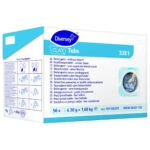
| CLAX Tabs | Tablets, 56 pcs | 2 tablets per load; 3 for heavy soiling | The simplest: no measuring, works in water of any hardness |
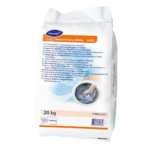
| CLAX Bioextra Conc White | Powder, 20 kg | 8–13 g light, 10–17 g medium, 14–24 g heavy soiling; 40–60 °C | White bed linen and towels, enzymes for protein stains |
| CLAX Saturn | Alkaline powder, 20 kg | 6–10 g light, 10–18 g medium, 15–30 g heavy | Booster for kitchen cloths and workwear |
| CLAX Oxy | Oxygen powder, 10 kg | 1–2 g light, 3–5 g medium, 5–6 g heavy; 70–80 °C | Bleaching and degreasing at high temperature |
| CLAX Activ Conc | Chlorine powder, 10 kg | 3.5–6 g at 50–60 °C | Bleaching and hygiene of white textiles |
| CLAX Pasta | Paste, 10 L | 0.5–1 ml light, 1–2 ml medium, 3–5 ml heavy | Directly on the stain or in the pre-wash |
The wall chart needs three columns, not one: “bed linen”, “towels”, “kitchen”, and for each how many grams per load for a 10, 15 or 20 kg machine. Staff do not multiply, they read. Next to it hangs a measuring cup with a marker line for each column. That single sheet of paper cuts detergent consumption by a fifth in the first month, as we have seen at our customers.
Automatic dosing: from three machines upwards
When a laundry washes 300 kg or more a day or has three or more machines, manual dosing stops being cheap. Staff spend time carrying containers, every shift doses differently, and when a complaint comes nobody knows how much of what went into the machine. An automatic system solves all three problems: liquid chemistry sits in 20 l containers in the store, pumps dose it according to the formula the machine calls, and consumption is recorded.
- Diversey DF10M MK2 — a central system for laundries with up to 8 machines (up to 100 kg per machine, 300 kg in total). Standard configuration 3 machines and 6 pumps, expandable to 8 machines and 9 pumps. Stores up to 99 wash formulas, has a built-in flow meter, and pushes the chemistry to the machine with water, so hoses last longer and dosing reaches machines up to 60 m away.
- Diversey DF20L — the larger model for industrial and hotel laundries: up to 10 machines and 8 to 10 different products.
- Both are part of the IntelliLinen platform: chemical consumption, machine operation and low-level alarms are visible on a cloud dashboard from a phone or laptop, and formulas can be changed remotely.
The liquid CLAX range for automatic dosing
Automatic dosing works with liquid concentrates in 20 l containers. Instead of one “complete” detergent, the formula is built from components: detergent, alkaline booster, bleach and a neutraliser in the final rinse. That way only the dose changes between bed linen, towels and kitchen cloths, not the product.
| Stage | Product | Dosing (ml per kg of dry linen) | Note |
|---|---|---|---|
| Main wash, detergent | CLAX 100 | 1.5–12 | Concentrate, white and colourfast textiles |
| Main wash, detergent | CLAX Plus PE | 6–13; 30–60 °C | Coloured and mixed linen; automatic or manual |
| Main wash, soft water | CLAX Profi | 3–9 light, 9–15 medium (below 8 °dH) | Complete detergent, soft water only |
| Delicate and coloured textiles | CLAX Mild | 4–16; 30–60 °C | Mild enzymatic, all water hardness |
| Alkaline booster | CLAX Build | 4–10 soft water / 16–28 hard water | With a surfactant booster; strength set by the dose |
| Surfactant booster | CLAX 200 Pur-Eco | 0.5–2 light, 2–5 medium, 3–6 heavy | Ecolabel, with CLAX Build or a detergent |
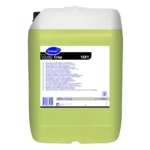
| Cold wash | CLAX Cool + CLAX Crisp | ≈ 10 + 4–5 | Lightly soiled bed linen and towels at room temperature |
| Bleaching, low temperatures | CLAX Bright Bleach | 4–5; 30–50 °C | Oxygen (PAP), not for wool and nylon |
| Bleaching and disinfection | CLAX Personril | 8–12; 60–70 °C | RKI approved, for healthcare and hotels |
| Chlorine bleaching | CLAX Hypo Conc | 4–7 light, 7–9 medium, 9–12 heavy | Low temperatures; never with acidic products |
| Final rinse | CLAX Neutrapur | 1.5–4 | Target linen pH ≈ 6.5; no skin irritation |
| Final rinse | CLAX Soft 2in1 | According to programme and water alkalinity | Neutraliser and softener in one |
| Hard water, sun-cream stains | CLAX Renova | 1–2; for sun cream 5–8 in a neutral pre-wash | Sequestrants, important for coastal hotels |
A 50 kg machine, medium-hard water, 30 °C: CLAX Cool about 10 ml/kg (500 ml) and CLAX Crisp 4–5 ml/kg (200–250 ml) in the main wash, CLAX Neutrapur 1.5–4 ml/kg in the final rinse. The same programme at 60 °C with CLAX 100 and Bright Bleach uses more energy but removes heavier stains, so the system keeps both formulas and staff choose the programme number.
Manual or automatic: a comparison
| Criterion | Manual dosing | Automatic dosing |
|---|---|---|
| Laundry size | 1–2 machines, up to about 300 kg a day | 3 or more machines, from about 300 kg a day |
| Form of chemistry | Powder, tablets, paste | Liquid concentrates, 20 l |
| Accuracy | Depends on the person and the shift | Same dose every time, flow meter |
| Staff safety | Contact with powder and concentrate | Closed system, only the container is replaced |
| Adjustment by linen type | Manual, by chart | Up to 99 formulas, called by the machine |
| Consumption control | Counting bags at month end | Per machine and programme, cloud report |
| Investment | Measuring cup and chart | Dosing system and installation; usually paid back through lower chemical use and fewer rewashes |
Five mistakes we see in laundries
- Dosing by drum volume instead of by kilogram of linen. A 20 kg machine full of towels and the same machine half full do not need the same dose.
- Ignoring water hardness. In hard water part of the alkali and surfactants is spent on limescale; that is why CLAX Build has a dose twice as high for hard water, and why CLAX Renova exists as an additive.
- Bleach without a neutraliser. Linen that comes out with a pH above 9 irritates the skin and wears out faster. Neutrapur in the final rinse costs 1.5 to 4 ml per kilogram.
- Mixing chlorine and acidic products. CLAX Hypo and Activ are chlorine-based, Personril and Bright Bleach acidic. In an automatic system separate pumps and the formula take care of it; with manual dosing every worker has to know it.
- An empty container mid-shift. An automatic system has a low-level alarm; with manual dosing the spare bag has to stand next to the machine, not in a storeroom on another floor.
Send us the number and capacity of your machines, the kilograms of linen per day by type (bed linen, towels, kitchen, workwear) and the water hardness if you know it, and we will propose a dosing system and formulas with dosing per kilogram. We install and programme the dosing equipment and train the staff on site.