 Office info
 Storage info
In short
- The price of a professional floor scrubber is not a single number: besides the machine you pay for batteries and a charger, brushes or pads, squeegee blades and service. That is why machines are compared by annual cost per square metre, not by the price on the invoice.
- With everything added up, a small walk-behind machine costs a site about 1 cent per m² of floor washed, a medium walk-behind about 0.4 cents and a large traction-drive machine about 0.3 cents. The wage of the person who operates the machine costs more than the machine itself, so a bigger machine on a bigger area is always cheaper per square metre.
- A used TASKI machine from a classified ad costs 20–40% of a new one, but ready for work it usually costs twice the advertised price: new batteries, squeegee blades, a brush and an inspection. It only makes sense for a proven model with service and spare parts available in the country.
- Buying pays off when the machine runs every day for more than three years. Renting is for a season, a trial period and one-off jobs. Leasing spreads the purchase into instalments that are lower than the saving on labour.
The first question we get when someone is looking for a floor scrubber is “how much does it cost”. The honest answer is: it depends on how many square metres you wash a day and how many years the machine will work. Two machines with the same price can end up costing completely different amounts, and a more expensive machine on the right site is often cheaper than a cheaper one. That is why here we explain what goes into the price, how to calculate the cost per square metre for three classes of machine, when a used TASKI machine makes sense and when renting or leasing beats buying.
What goes into the price of a professional machine
A scrubber-drier scrubs the floor with a brush or pad, applies the solution and vacuums up the dirty water in a single pass, so the floor is dry straight away. When you buy one, you pay for five things, and usually only the first shows on the invoice.
- The machine. The body with its tanks, the brush motor, the vacuum motor and the electronics; on TASKI machines also the built-in charger (BMS), and on the ULTIMAXX series the display and telemetry. This is 70–85% of the purchase price.
- Batteries. The most expensive consumable part. Gel batteries last 500–1,000 charge cycles, which at one charge a day means replacing them every 2–4 years. Li-Ion batteries last 2,000 cycles or more, that is as long as the machine itself, but are 50–100% more expensive at the start.
- Brushes or pads. A brush is replaced every 1–2 years, a pad driver lasts longer, and pads wear out constantly.
- Squeegee blades. The front and rear blades of the squeegee leave the floor dry; they are replaced once or twice a year. They are cheap, but without them the machine loses its purpose.
- Service. An annual inspection, a battery check, seals, hoses, occasional repairs. For a machine that runs every day, count on about 3% of the purchase price a year for service and the same again for wear parts. With regular service a TASKI machine works for 8–10 years.
Chemicals and water are a negligible cost: the machine uses 20–140 ml of solution per m² at a concentrate dosage of 0.5–1%, so a litre of product covers several thousand square metres.
Why compare cost per m² and not price
You buy a machine once, but you wash the floor every day, so the price has to be spread over all the square metres the machine will wash. We do it like this: the purchase price is divided over 8 years, and replacement batteries, service, wear parts and the cost of financing (interest, or the money tied up in the machine) are added. That gives the annual cost of the machine, and divided by the square metres the machine washes in a year it gives the cost per m².
That figure is compared with the cost of labour. A person with a mop cleans 150–250 m² an hour, with a walk-behind machine 800–1,300 m² an hour. At a net wage of €800, an effective working hour of a cleaner in Montenegro in 2026 costs about €6.40 (the calculation is in our article on when a robot pays off). Mopping therefore costs about 3 cents per m² for labour alone, more than the machine and labour together in any class.
Cost per m² and per year for three classes of machine
We have divided TASKI walk-behind machines into three classes by the area they realistically wash each day. Output is the practical figure, about 65–75% of the theoretical one in the data sheet, because in practice time is lost on turning, obstacles and refilling water. For each class we took a typical site and 300 working days a year.
| Class | Models (TASKI) | Working width / practical output / tank | Typical site | Indicative price of a new machine (excl. VAT) | Annual machine cost | Machine cost per m² |
|---|---|---|---|---|---|---|
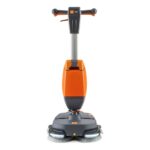
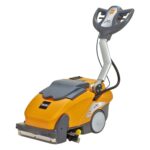
| Small walk-behind | swingo 350B, swingo 455 B, ULTIMAXX 360 | 38–49 cm / 800–1,000 m²/h / 4–22 l | up to 500 m² a day: washrooms, kitchens, small shops (example: 400 m² a day, 120,000 m² a year) | €3,800 to €5,500 | about €1,150 (€96 a month) | about 1.0 cent |
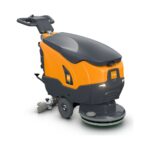
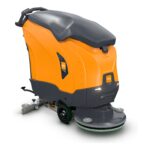
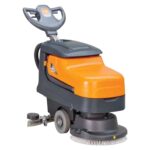
| Medium walk-behind | swingo 755B, ULTIMAXX 900, ULTIMAXX 1900 Economy | 43–55 cm / 1,000–1,300 m²/h / 20–43 l | 1,000–2,500 m² a day: hotels, supermarkets, schools, hospitals (example: 1,500 m² a day, 450,000 m² a year) | €5,000 to €12,000 | about €1,900 (€160 a month) | about 0.4 cents |
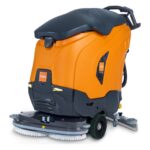
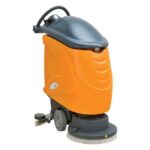
| Large with traction drive | ULTIMAXX 2900 Performance, swingo 1650, swingo 855 B Power | 50–65 cm / 1,700–2,200 m²/h / 63–85 l | 2,500–5,000 m² a day: shopping centres, halls, car parks, sports facilities (example: 4,000 m² a day, 1,200,000 m² a year) | €13,000 to €21,000 | about €3,950 (€330 a month) | about 0.3 cents |
The price ranges come from the public price lists of TASKI partners in the EU (Germany, Poland, the United Kingdom) and the USA in autumn 2026, for a configuration with gel batteries, a built-in charger and a brush, excluding VAT and converted into euros; Li-Ion versions are more expensive. We quote the price for your site and configuration in an offer. Annual cost: depreciation over 8 years, gel batteries replaced every 3 years, service and wear parts at 6% of the price a year, financing at 6% on the average debt.
In the medium class, for example, the annual cost consists of depreciation of about €1,000, batteries of about €200, service and wear parts of about €480 and financing of about €240. Batteries, squeegee blades, brushes and service are a third of the cost, so a machine bought “without everything” is not a saving. Once you add the wage of the person who operates the machine, the picture becomes clear:
| Method of washing | Output | Machine per m² | Labour per m² (€6.40/hour) | Total per m² | A 1,000 m² floor costs |
|---|---|---|---|---|---|
| Mop and bucket | 200 m²/h | — | 3.2 cents | 3.2 cents | €32 a day |
| Small walk-behind machine | 900 m²/h | 1.0 cent | 0.7 cents | 1.7 cents | €17 a day |
| Medium walk-behind | 1,200 m²/h | 0.4 cents | 0.5 cents | 0.9 cents | €9.50 a day |
| Large with traction drive | 1,900 m²/h | 0.3 cents | 0.3 cents | 0.6 cents | €6.60 a day |
The machine cost per m² applies to the area in the previous table. A large machine bought for 1,000 m² a day costs 1.3 cents per m² for the machine alone, because its annual cost is spread over four times fewer square metres.
An oversized machine is the most common mistake. A medium machine bought for 400 m² a day costs more per square metre than a small one and saves only about ten minutes of work a day. Conversely, a small machine on 1,500 m² a day needs three or four tank refills and almost two hours of operating time, so the price difference to the medium class is paid back through wages in under two years. Choose by daily area, not by price.
New or used TASKI machine
TASKI machines are in demand on the used market precisely because they last so long, so the swingo 455, 755 and 1650 are common in ads in the region and the EU. In autumn 2026 a swingo 755B from 2018 is offered for €850 to €1,900 without a warranty, and the same machine refurbished by a service company, with new batteries and a six-month warranty, for about €2,700. A refurbished swingo 455 B costs about €2,200, while old machines with a cable or without batteries are offered for a few hundred euros. Roughly: a used machine costs 20–40% of a new one.
That price is rarely the final one. A machine from an ad almost always needs a new set of batteries (gel batteries over three years old are near the end of their life), new squeegee blades, often a brush or pad driver as well, and a service inspection. A used machine advertised at €1,000 therefore costs about €2,000 ready for work, close to the price of a refurbished machine from a service company with a warranty. If the difference from a new one is smaller than the annual cost in the table, the new one is the better choice: it has a warranty, new batteries and its whole life ahead of it.
What to check on a used machine
- Running hours. TASKI machines count running hours on the display (ULTIMAXX also in telemetry). A machine that runs an hour a day accumulates 250–300 hours a year; under 1,000 hours means little use, over 2,500 means serious work and you should count on replacing the brush motor and the vacuum motor.
- Batteries. Ask for the date of manufacture and run the machine on a full battery for at least half an hour. If the runtime drops below half of the nominal, the batteries need replacing, and that should be deducted from the price.
- Vacuum motor and squeegee. On a wet floor the squeegee must leave a dry trail. A wet trail means worn blades, a bad hose or a weak motor; a motor that “whines” or vibrates means costs soon to come.
- Tanks, charger, electronics. Cracks and hard lid seals (a tank that does not hold vacuum does not pick up water); the charger must start and the display must show no fault. Replacing the built-in charger is expensive.
- Spare parts and service. Ask who will service the machine and whether parts exist for the model. For the swingo and ULTIMAXX series Interesta keeps blades, brushes, pads and batteries in stock in Podgorica and services machines wherever they were bought.
A used TASKI machine is a good choice for a site that is just introducing machine cleaning and is not sure how much it will use it, for a seasonal site that operates five months a year and for a second machine that complements a new one. It makes no sense when the machine is the only one at a site that is cleaned every day and cannot be left without it, or when it is bought without service and spare parts in the country: a repair from abroad takes weeks, and in the meantime the mop is back in use.
Buying, renting or leasing
Three ways to get a machine, three different calculations.
- Buying is the cheapest in the long run. It pays off when the machine runs every day and you will use it for at least three years; TASKI machines in practice work for eight to ten. A VAT payer deducts the VAT, and the machine is depreciated through expenses.
- Renting is the most expensive per month, but without obligations: batteries, service and parts are the lessor’s concern. Daily rental of small machines in the region costs €20–45, and monthly rental in the trade is 3–5% of the price of a new machine, so over a year you pay a third to a half of the machine. It makes sense for a season, a trial period and one-off jobs (opening a site, cleaning after construction).
- Leasing is buying in instalments: a down payment of 10–20%, a term of 36–60 months. Banks in Montenegro finance equipment through leasing from €5,000 upwards, for up to 84 months. The instalment for a medium-class machine over four years is in the order of €150–250 a month, for the small class €80–120, in most sites lower than the saving on labour in the same month.
Example: a hotel with 100 rooms
A hotel with 100 rooms has 1,500–2,500 m² of public areas (lobby, corridors, restaurant, spa), which is the medium class: ULTIMAXX 1900 or swingo 755B. If it operates all year, the machine costs about €1,900 a year (€160 a month) and replaces at least three hours of manual work a day (about €570 a month at a net wage of €800). Buying or leasing over 48 months, no dilemma.
If the hotel operates six months a season, renting for the season costs 18–30% of the price of the machine, so after three to four seasons you have paid for the machine and do not own it. Buying is still cheaper if the machine spends the winter in a dry place, with gel batteries topped up once a month (Li-Ion copes with winter more easily). A hotel that is not sure it will operate for more than two or three seasons rents; a hotel that stays buys or leases, and a refurbished used machine from a service company with a warranty gives a seasonal site the lowest annual cost.
Example: an 800 m² supermarket
A supermarket washes 800 m² every morning, 365 days a year. That is the border between the small and medium class: the ULTIMAXX 360 washes 800 m² with two tank refills in a little under an hour, the swingo 455 B or 755B in about 45 minutes without refilling. With a mop the same floor takes four hours. The saving is three hours a day, about €19 a day or €570 a month, and the leasing instalment for a small machine is under €120. Renting makes no sense here: the machine runs every day, so over a year of rental you pay half of a new one. Buy straight away, or lease if the cash is needed for stock.
How to choose a model
The cost per m² tells you which class to take; within the class the model is chosen by the floor surface, the aisles, noise and the people who work with the machine. We explained that in the guide on how to choose a TASKI floor scrubber by floor area, with a table of models by daily area. If the area is over 1,500 m² and is washed every day when nobody is around, also read when a floor cleaning robot pays off: a robot is not cheaper than a machine per square metre, but it replaces a worker you cannot find.
Send us the area you wash daily, the type of floor and whether the site operates all year, and we will send an offer with the price of the machine, batteries and wear parts over five years, side by side for buying and leasing. You can try the machine at your site before deciding. We provide service and spare parts for TASKI machines, new and used, in Podgorica.
Sources
- Technical data for the models: product pages for TASKI swingo 350B, 455 B, 755B, 855 B, 1650 and ULTIMAXX 360, 900, 1900, 2900 on interesta.net
- TASKI — ULTIMAXX 1900 and 900, theoretical and practical output by configuration
- TASKI eShop (Germany) — ULTIMAXX 2900 Double Disc Performance, price list
- Linea (Poland, TASKI partner) — swingo 455 B BMS and swingo 755 B Eco BMS, prices with gel batteries
- Perfect Plus (Poland) — ULTIMAXX 2900 DD65 Performance, price
- Diamond Tool Store (USA) — ULTIMAXX 1900, 2900 and swingo 1650, prices
- Astral Hygiene (UK) — swingo 350 B BMS and swingo 1650 B Li-Ion, prices excluding VAT
- Monster Janitorial (USA) — ULTIMAXX 360 RTU complete, price
- TASKI eShop — swingo squeegee blade, price
- AllBatteries (UK) — 12 V gel battery for TASKI swingo, price
- CleanLink — comparison of gel and Li-Ion batteries (cycles, price)
- Tennant — choosing batteries for floor machines (life in cycles)
- Machineryline — listings of used TASKI machines (swingo 755B, 1650, 4000)
- KupujemProdajem (Serbia) — listings of used TASKI swingo machines
- MM Elektro (Poland) — refurbished swingo 755B and 455B with warranty, prices
- Kleinanzeigen (Germany) — used swingo 455 B and 755 BT, prices
- Dajnadan (Serbia) — daily rental of floor scrubbers, prices
- Erste Bank Montenegro — leasing terms (amount, term)
- Interesta — When does a floor cleaning robot pay off (cost of a working hour in Montenegro, 2026)