Office info
 Storage info
In short
- Professional cleaning chemicals are bought as concentrate but paid for per litre of working solution, not per litre in the canister. A 5-litre canister that costs as much as ten supermarket bottles makes hundreds of bottles of ready solution.
- The difference is largest for spray tasks: a litre of solution for washrooms, kitchens, glass or disinfection made from concentrate costs from a few cents to about €1, while a ready-made supermarket spray costs about €3 to €6.50. The supermarket is usually 10 to 20 times more expensive, and even more for disinfection.
- For floor cleaning the price per litre looks similar on paper, 1 to 6 cents, as long as the supermarket product is also dosed exactly as the label says. In practice it is not: household products have no dosing system, so they are poured with the cap or by eye, often at double strength. A professional floor cleaner always comes with a dosing system, and that is where the saving is made.
- Concentrate only pays off with accurate dosing. A double dose means a double bill, a sticky floor and foam in the machine, which is why dosing systems (QuattroSelect, SmartDose, Exact, wall-mounted dispensers) save more than they cost.
When a restaurant owner or a hotel housekeeper asks us why they should pay for a canister of professional chemicals instead of buying cleaning products at the supermarket, the answer lies in a calculation that is rarely made: how much a litre of what you actually clean with costs. On the shelf, a 5-litre canister is more expensive than a 750 ml bottle, so the supermarket looks cheaper. But the canister is used to make a working solution diluted to between half a percent and a few percent, so one litre of concentrate becomes 20 to 200 litres of solution. In this guide we explain the difference between concentrates, ready-to-use products and Pro Formula, calculate the price of a litre of working solution for five typical tasks, and show where professional chemicals save money and where they do not.
What professional cleaning chemicals are
Professional cleaning products are made for sites that clean every day, with trained staff and set procedures: hotels, restaurants, hospitals, schools, offices and laundries. They differ from supermarket products in four ways:
- Concentration. Most are supplied as a concentrate that is diluted with water, so you pay for the active ingredients, not for water and packaging.
- Purpose. Each product is made for a specific task and surface: neutral for floors, acidic for washrooms and limescale, alkaline for kitchen grease, and disinfectants with efficacy proven to EN standards. It is clear what may be used on marble, on stainless steel and on a floor finish.
- Dosing. Each product comes with a set dose for a bucket, a spray bottle and a machine, and larger sites also get a dosing system that delivers that dose automatically.
- Documentation. A safety data sheet (SDS), a technical data sheet and, for disinfectants, efficacy and approval data. This is what the sanitary inspection asks for and the basis for HACCP and a cleaning plan.
On our website these products are in the professional cleaning chemicals category, and most of them are Diversey ranges: TASKI for floors, washrooms and surfaces, Suma for kitchens, Room Care for hotel rooms, Clax for laundries, and Pro Formula with the Cif, Domestos and Omo brands.
Concentrate, ready-to-use or Pro Formula
The same chemistry comes in several formats, and the format determines both the price per litre and how easy it is to get the dose wrong.
| Format | How it is used | Examples | When it makes sense |
|---|---|---|---|
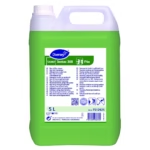
| Concentrate in a canister (5 L, 20 L) | Diluted with a measuring cup or a wall-mounted dispenser into a bucket, bottle or machine | TASKI Jontec 300, Suma Multi D2, Suma Bac D10 | High consumption and staff who dose accurately, ideally with a wall-mounted dispenser |
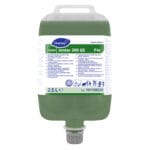
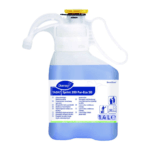
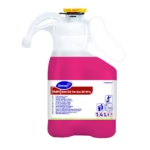
| Concentrate in a dosing system | A pouch or bottle with a built-in dose: QuattroSelect (2.5 L), SmartDose (1.4 L), Exact (1 L) | Jontec 300 QuattroSelect, Sprint 200 SmartDose, Sani Cid SmartDose | Hotels, hospitals, sites with several shifts and changing staff; the dose cannot be missed |
| Ready-to-use (RTU) | Used straight, without dilution | Oxivir Plus Spray, Sprint Glass 5 L | Low consumption, occasional tasks, places without water for dilution, quick disinfection |
| Pro Formula | Professional versions of well-known brands, in 750 ml bottles and 5 L canisters for refilling or dilution | Cif Pro Formula, Domestos Pro Formula | Holiday apartments, small accommodation, offices and cafés that want a familiar brand and simple instructions |
Per litre of concentrate, a dosing system is the most expensive format, because you also pay for the packaging with the dispenser. Even so, in practice it usually gives the lowest bill: staff cannot add “a little extra just in case”, and consumption can be calculated in advance. A ready-to-use product is the most expensive per litre of solution, but there is no point diluting concentrate for one bottle a month.
How to calculate the price of a litre of working solution
The calculation is simple: the price of a litre of concentrate multiplied by the dose. If a litre of concentrate costs €6 and the dose is 0.5% (50 ml in 10 litres of water), a litre of working solution costs €6 × 0.005 = 3 cents, and a 10-litre bucket 30 cents. The same product in a spray bottle at a 2% dose gives a litre of solution for 12 cents and a 750 ml bottle for 9 cents.
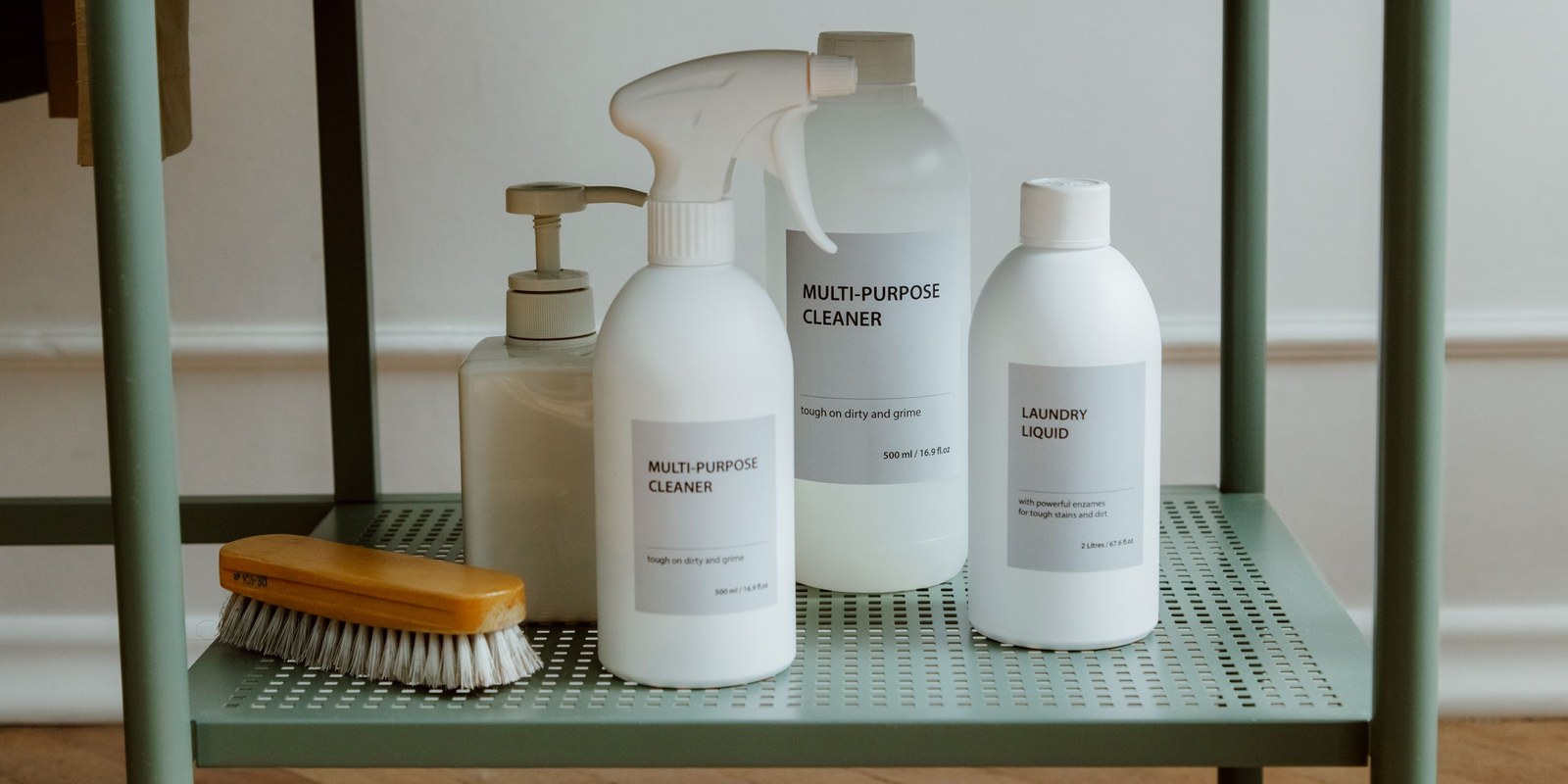
For a ready-made supermarket product the calculation is even shorter: the price of the bottle divided by its volume. A 750 ml spray for €2.40 excluding VAT means €3.20 per litre. That is the price to compare with 3 to 12 cents from concentrate.
Two things are worth knowing before you compare. First, the dose on the label is the minimum dose for normal soiling; for heavy soiling it rises two to five times, for professional and supermarket products alike. Second, many supermarket products are not diluted at all (sprays, gels), so the price of the bottle is also the price of the solution.
What a litre of solution costs for five typical tasks
We compared professional products from our range with the products most often bought at the supermarket for the same tasks. Doses are taken from the manufacturers’ technical data sheets, for normal soiling.
| Task | Professional product and dose | Litre of working solution | Supermarket product | Litre from the supermarket |
|---|---|---|---|---|
| Floor cleaning (bucket or machine) | TASKI Jontec 300 via a wall-mounted dispenser, 0.5%; QuattroSelect or SmartDose, 0.2% | 1–6 cents, always the exact dose | liquid floor cleaner, 4–12 ml per litre of water according to the label, dosed with the cap | 1–4.5 cents by the label, 2–9 cents at double dose |
| Washrooms (spray, daily) | TASKI Sani Cid SmartDose, 1 pump into a 500 ml bottle (1%); 0.3% for a bucket | 21–44 cents (spray), 6–13 cents (bucket) | bathroom or toilet spray, 750 ml | about €3 |
| Kitchen grease (spray) | Suma Multi D2, 5 ml per 750 ml; Cif Pro Formula Degreaser concentrate, 20 ml per 750 ml | 5–14 cents | degreaser spray, 650 ml | about €3.20 |
| Glass and mirrors | TASKI Sprint 200 SmartDose, 1%; Sprint Glass QuattroSelect, 5% | 23 cents – €1.05 | glass spray, 750 ml | about €3.20 |
| Surface disinfection | Suma Bac D10, 1%; Cif Pro Formula Safeguard, 1%; Oxivir Plus concentrate, 3.5% | 4–55 cents | disinfectant spray, 500 ml | about €6.40 |
Prices of professional products come from the public price lists of Diversey partners in the EU (Poland, Slovenia, Germany, Latvia, United Kingdom) in October 2026, for 5 L canisters and dosing packs, excluding VAT and converted to euros at the ECB rate; the ranges run from the lowest to the highest price found. Supermarket prices are regular (not promotional) prices in a Montenegrin online supermarket in October 2026, also excluding VAT. We give the price for your site and quantities in a quotation.
The table tells two different stories.
For spray tasks professional chemicals are usually 10 to 20 times cheaper per litre: three to fourteen times for glass, twenty times or more for kitchen degreasers and disinfection. A supermarket spray is a ready-made product: you pay for water, a bottle, a trigger and transport with every bottle. Concentrate goes into the same spray bottle for months; a 5-litre canister makes 140 to 250 bottles of 750 ml, and a 1.4-litre SmartDose bottle about 280 bottles of 500 ml. There is also less packaging to throw away, and fewer bottles take up less room in the store.
For floor cleaning the price per litre looks similar on paper: 1 to 6 cents for Jontec and 1 to 4.5 cents for a supermarket product, but only if that product is also dosed exactly as the label says. In practice this does not happen. Household floor cleaners have no dosing system at all; they are poured with the cap, straight from the bottle or with “a little extra so it smells nicer”, so the bucket easily ends up with a double or triple dose. With us, a professional floor cleaner always comes with some form of dosing system: a wall-mounted dispenser for the canister, a QuattroSelect pouch or a SmartDose bottle with a pump. The dose is the same every time, no matter who fills the bucket, and that is where the saving is made. The other part of the saving is on the floor and the machine. Supermarket products usually foam more and contain more fragrance; in a floor scrubber the foam gets into the recovery tank and up to the vacuum motor, and on the floor it leaves a film that attracts dirt, so the floor has to be washed more often. Jontec 300 is neutral, low-foaming and dries without streaks, so it does not damage the floor finish. We worked out how much the machine and labour cost per square metre, compared with the chemicals, in our guide what a floor scrubber costs; chemicals are the smaller part of the bill there, but the wrong chemicals shorten the life of the machine.
The most expensive chemical is the one dosed by eye. An extra capful in the bucket is not a safety margin but a double bill: the floor stays sticky, glass is left with streaks, and in washrooms acid builds up on the fittings. That is why we always supply professional floor chemicals with a dosing system, even though a dosing pack costs more per litre than a canister: the exact dose pays that difference back, because no more is ever poured than is needed. If you already work with canisters, a measuring cup and a dosing chart on the storeroom wall are the first step, and a QuattroSelect or R-Gap wall-mounted dispenser the next.
Example: a restaurant with 80 covers
Take a restaurant with a kitchen, a dining room for 80 guests and two toilets, open every day. Each month it washes the floor with two 10-litre buckets a day (600 litres of solution) and uses roughly 20 bottles of washroom spray, 15 of kitchen spray, 6 of glass cleaner and 10 of disinfectant, 51 bottles of 750 ml in total.
| Task | Monthly solution used | Supermarket products | Professional concentrates |
|---|---|---|---|
| Floors | 600 L | €6–27 by the label, €12–54 at double dose | €7–35 with a dosing system |
| Washrooms (spray) | 15 L | about €43 | €3–7 |
| Kitchen (spray) | 11 L | about €36 | €1–2 |
| Glass | 4.5 L | about €14 | €1–5 |
| Disinfection (Suma Bac D10) | 7.5 L | about €48 | about €1 |
| Total per month | about €150–195 | about €13–50 |
Excluding VAT, at the prices and doses in the previous table. The consumption is an example, not an average; for your site we calculate it from the floor area and the cleaning plan.
The difference is about €100 to €180 a month, or €1,200 to €2,150 a year. Most of it comes from the sprays, because the restaurant stops buying ready-made bottles, and on the floors from the fact that the dosing system does not allow a double dose. Fifty fewer bottles are thrown away every month. About ten professional spray bottles are needed, colour-coded and labelled by purpose, and they last for months.
For a hotel the picture is the same, only larger: in every room the housekeeper uses a bathroom spray, a surface spray and a glass spray, so a 100-room hotel uses hundreds of bottles of solution a month. How this is organised with the Room Care system, a fixed 15 ml dose and colour coding by purpose is explained in our hotel room cleaning plan.
Disinfection: when it is needed and when detergent is enough
The biggest price difference is in disinfection, and this is also where most mistakes are made. A disinfectant is not a stronger cleaner but a product with proven action against bacteria, yeasts or viruses at a precisely defined concentration and contact time. Suma Bac D10 is bactericidal at 1% for five minutes in dirty conditions; dilute it further and you have expensive water, wipe it off straight away and there has been no disinfection at all.
Disinfection is needed on food-contact surfaces, in washrooms, in healthcare and wherever the HACCP plan requires it. Dining-room floors, offices and corridors are washed with detergent; a disinfectant there only makes cleaning more expensive. Two-in-one products such as Suma Bac D10, Cif Pro Formula Safeguard or TASKI Sani 4 in 1 Plus for washrooms clean and disinfect in a single pass, so they save time as well. We describe the kitchen procedure step by step, with the Suma programme, in our guide to HACCP kitchen hygiene.
How to switch to professional chemicals
- List tasks, not products. What is cleaned, how often and on which surface. Most restaurants and smaller hotels need five to seven products, not twenty.
- Choose the format by consumption. A canister with a dispenser for what is used every day, a ready-to-use product for what is used once a month.
- Introduce accurate dosing. A dosing system, a measuring cup or at least a dosing chart on the wall. Without it, concentrate loses its point.
- Label the bottles. Colour and name by purpose, so the acidic washroom cleaner never ends up on the marble in the lobby.
- Train staff and keep the documentation. Safety data sheets and the cleaning plan in one place; it is the first thing the inspector asks for.
Send us what you clean and how much product you buy each month, and we will propose a range with doses and calculate the monthly cost alongside what you pay now. We install and set up the dosing equipment on site and train your staff. For laundries, where the dose determines both the cost and the colour of the towels, read manual or automatic dosing in the laundry.
Sources
- Dosing of professional products: product pages for TASKI Jontec 300, Sprint 200, Sani Cid, Sprint Glass, Suma Multi D2, Suma Bac D10, Oxivir Plus and Cif Pro Formula on interesta.net
- Diversey — TASKI Jontec 300 technical data sheet, 5 L canister (bucket and machine dosing)
- Diversey — TASKI Sani Cid technical data sheet (dosing)
- Higienaa (Poland) — TASKI, Suma and Oxivir, prices of canisters and dosing packs
- Franz Mensch (Germany) — TASKI Jontec 300, Sprint Glass, Suma Bac D10, Oxivir Plus and SmartDose, prices excluding VAT
- IG Group (United Kingdom) — Suma Multi D2, Jontec 300, Sprint 200 SmartDose, prices excluding VAT
- Peter Cox Catering (United Kingdom) — Cif Pro Formula, prices excluding VAT
- European Central Bank — euro reference exchange rates (20 October 2026)