Office info
 Storage info
In short
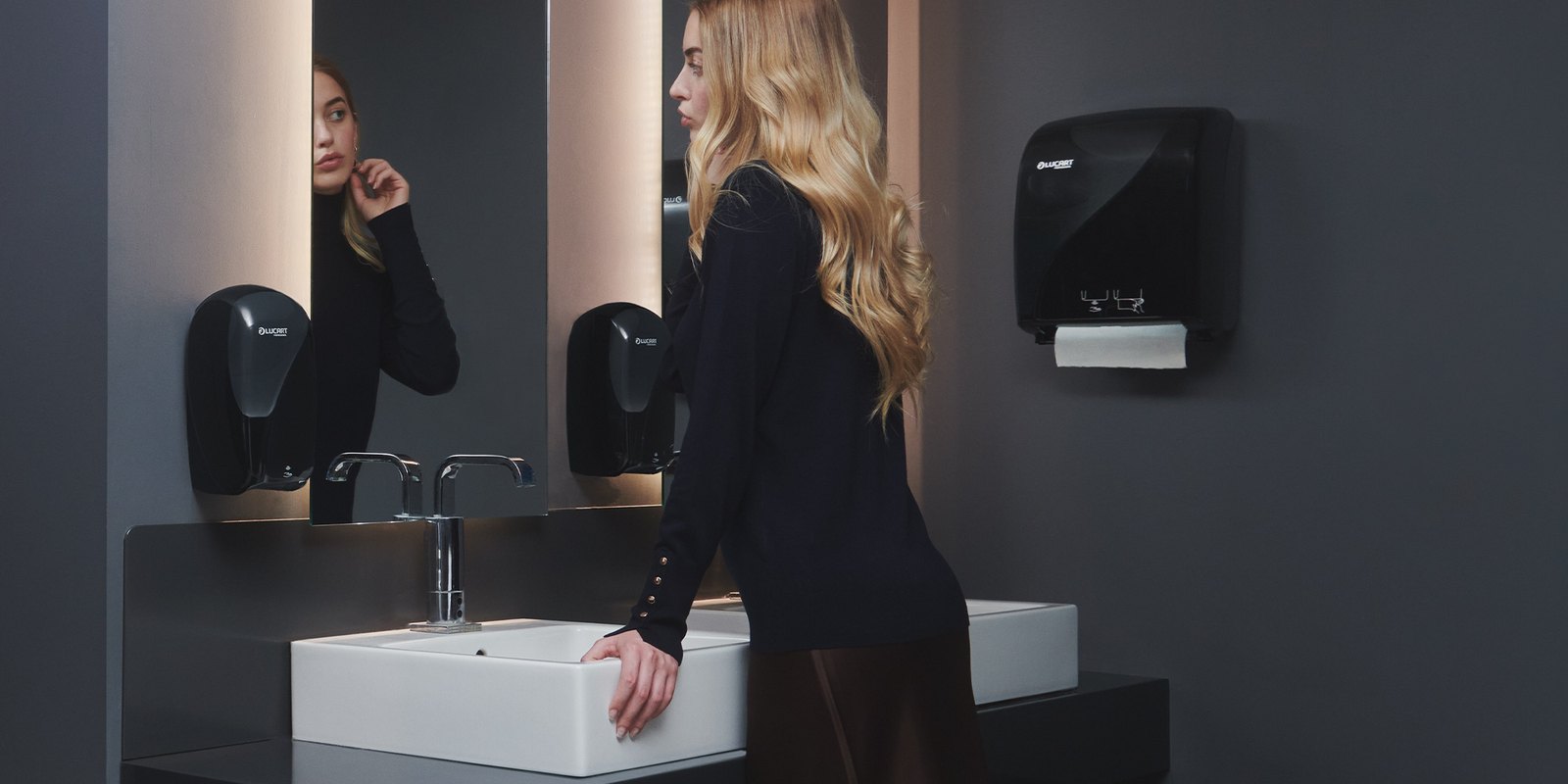
- In a shared washroom it is the dispenser, not the paper, that decides how much is used: a system that releases one sheet at a time gives every user the same amount, however hard they pull.
- A paper towel dispenser and a toilet paper dispenser work as a closed system with their own refill: Aquarius with Scott and Hostess paper (Kimberly-Clark Professional), Identity and L-One with Lucart rolls.
- Large rolls mean fewer refills: one jumbo toilet roll of 202 to 314 m replaces 10 to 16 ordinary rolls, so empty holders become rare.
- Hygiene is the second reason: the user touches only the sheet they take, and the paper stays enclosed, protected from water, dust and hands.
Washroom paper supplies for hotels and restaurants in Montenegro are rarely discussed until something goes wrong: an empty holder in a restaurant washroom on a Friday night, towels scattered around the basin, a blocked toilet because someone threw in half a roll. All three problems have the same cause, and it is not the paper but the way it is released. In our guide on how much paper a hotel uses per room we showed how consumption is calculated. Here we pick up the part about public washrooms: why a dispenser pays off, which types exist and which refill goes into which system, with examples from the Kimberly-Clark Professional and Lucart Professional ranges we supply.
Why a dispenser rather than a roll on a holder
A plain holder and an open basket of towels share one weakness: the user decides how much to take. One pull on an ordinary roll unwinds a metre of paper, and a hand in a stack of folded towels comes out with five instead of two. A dispenser takes that decision over, in one of three ways.
- Sheet by sheet. Folded hand towels and interfolded toilet tissue come out one at a time. Anyone who wants more has to pull again, and most people stop at two.
- Autocut. The dispenser cuts a sheet of the same length every time: 26.5 cm for hand towel and 22.5 cm for toilet paper in the Lucart Identity system. Consumption becomes measurable per user.
- Centrefeed. The paper is drawn from the centre of the roll through a narrow opening, sheet by sheet, while the whole roll stays enclosed in the housing.
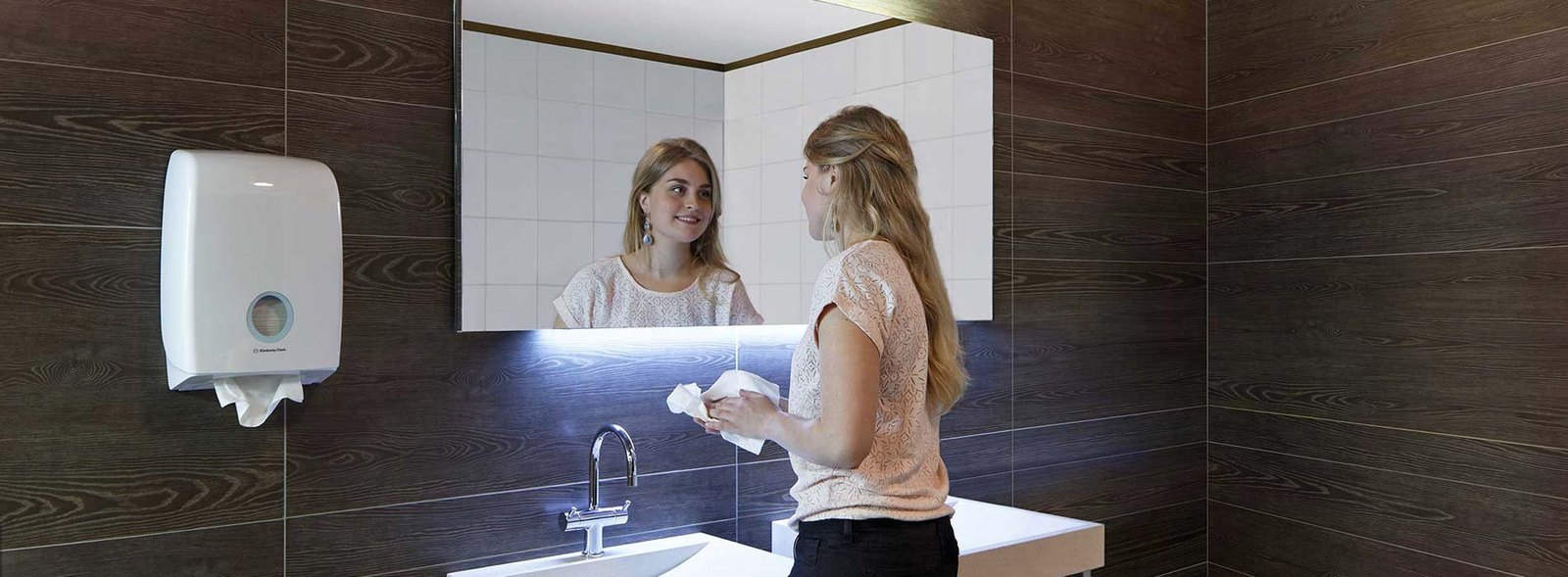
The second benefit is hygiene. With all three systems the user touches only the paper they take, not the roll, the stack or the housing. The World Health Organization’s hand-washing guidance asks for hands to be dried with a single-use towel and for the same towel to be used to turn off the tap. That only makes sense if the towel was clean until that moment, which means enclosed in a dispenser rather than stacked on the edge of the basin.
The third benefit is staff time. A high-capacity dispenser is refilled once a shift or less often, has a window or slot that shows the paper level, and locks, so refills do not disappear from the washroom.
Dispenser types and which refill goes where
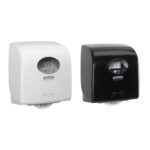
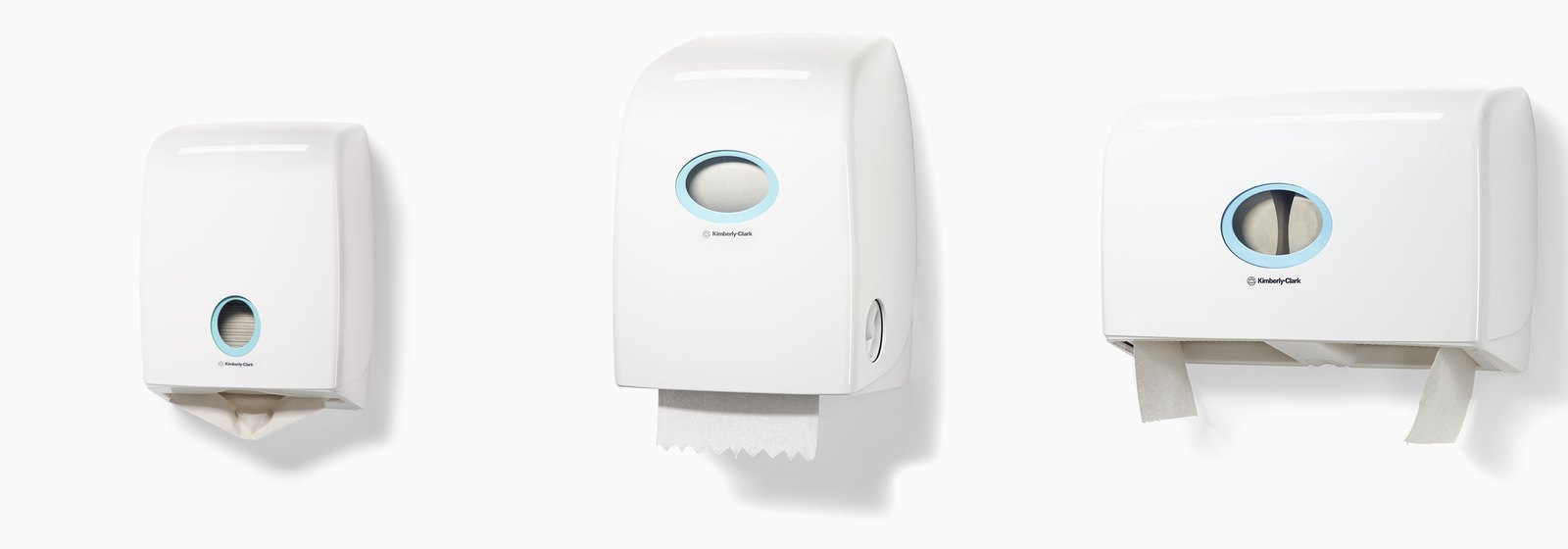
The figures in the table come from the manufacturers’ specifications published on the product pages. Most of the dispensers in the table are available in white and in black.
| Type | Dispenser | Refill | Refill capacity | Where |
|---|---|---|---|---|
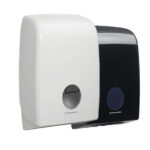
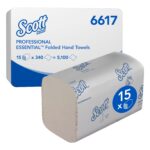
| Folded hand towels (V-fold, interfold) | Aquarius folded hand towel dispenser | Scott Essential folded hand towels | 340 sheets per sleeve, 15 sleeves per case (5,100 sheets), sheet 21 × 20 cm | Guest washrooms, kitchens (the paper is approved for food contact) |
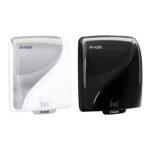
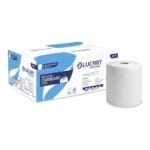
| Roll towel, autocut | Lucart Identity Autocut; touch-free: Identity Touch Free | Lucart Identity Strong 155 ID | 155 m per roll, 6 rolls; sheet 26.5 cm, about 585 sheets per roll | Busy washrooms, kitchens, healthcare |
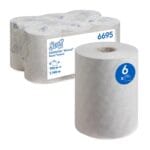
| Roll towel, large and compact roll | Aquarius roll towel dispenser; for small washrooms Aquarius Slimroll | Scott Essential 6 × 350 m; Scott Essential Slimroll 6 × 190 m | 350 m per roll; Slimroll 190 m, 760 sheets per roll | The busiest washrooms; Slimroll where wall space is tight |
| Centrefeed towel | Lucart L-One Maxi | Lucart EcoNatural Maxi | 150 m per roll, 6 rolls, 2-ply | Kitchens, bars, workshops, back-of-house areas |
| Toilet paper, jumbo roll with autocut | Lucart Identity Autocut for toilet paper | Lucart Identity Strong 900 ID | 202 m and 900 sheets per roll, 12 rolls; sheet 22.5 cm | Hotels, restaurants, offices, schools |
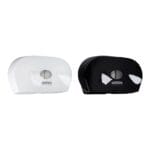
| Centrefeed toilet paper | Aquarius twin (two rolls); Aquarius 7046 (one large roll) | Scott Control 12 × 204 m; Scott Control 6 × 314 m | 204 m and 833 sheets per roll; or 314 m and 1,280 sheets per roll | Busy washrooms; both dispensers project only about 13 cm into the cubicle |
| Interfolded toilet tissue | Aquarius folded toilet tissue dispenser | Hostess interfolded toilet paper | 250 sheets per sleeve, 32 sleeves per case (8,000 sheets) | Guest washrooms, clinics; can be topped up before it runs empty |
| Soap (same design as the paper dispenser) | Aquarius hand soap dispenser 1 L; Lucart Identity Soap 1000 | Scott Essential foam hand soap; Lucart Identity 1 L cartridges | 1 L cassette; Scott Essential gives 2,500 doses per cassette | At every basin |
All towel dispensers are in the category paper towel dispensers, and those for toilet paper in toilet paper dispensers.
Controlled consumption: a worked example for hand towels
Take the washrooms of a restaurant or hotel lobby where hands are washed 300 times a day, or 9,000 times a month. The assumption is that two sheets are enough to dry hands, as the manufacturers state for Scott Airflex and Lucart Identity towels. That is 18,000 sheets a month.
| System | Sheets per unit | Per month at 2 sheets per wash | Per month at 3 sheets per wash |
|---|---|---|---|
| Scott Essential folded towels in an Aquarius dispenser | 340 per sleeve | 53 sleeves (about 3.5 cases) | 79 sleeves (about 5.3 cases) |
| Lucart Identity Strong 155 in an Autocut dispenser | about 585 per roll | 31 rolls (about 5 cases) | 46 rolls (about 7.7 cases) |
| Scott Essential Slimroll in an Aquarius Slimroll dispenser | 760 per roll | 24 rolls (4 cases) | 36 rolls (6 cases) |
An example, not a standard. The sheets are not the same size (21 × 20 cm folded, 25 cm on the Slimroll roll, 26.5 cm on Identity autocut), so the systems should not be compared by case count alone. Count your real consumption for the first month and correct the assumption.
The table shows the point that matters most: every extra sheet per hand wash raises consumption by half. A sheet-by-sheet dispenser cannot force a user to take exactly two sheets, but each further sheet needs another pull, and that is enough to stop most people. With an open basket or loose folded towels there is no such brake, and that is where the gap between the third and fourth columns comes from.
Toilet paper: fewer refills and fewer empty holders
With toilet paper the main saving is not in sheets but in labour and in empty holders. A standard guest-room roll holds about 19 m of paper (Lucart Strong Select 4 has 140 sheets and 18.9 m). This is how many times a dispenser has to be opened to use 1,000 m of paper:
| System | Metres per fill | Fills per 1,000 m |
|---|---|---|
| Standard roll on a holder | about 19 m | 53 |
| Lucart Identity Strong 900 (autocut) | 202 m | 5 |
| Scott Control in Aquarius 7046 | 314 m | 3 to 4 |
| Scott Control in the Aquarius twin dispenser (two rolls) | 408 m | 2 to 3 |
One 202 m jumbo roll replaces more than ten ordinary rolls, and a 314 m roll more than sixteen. The twin dispenser has a further advantage: the first roll is used up completely before the second one starts, so there are no half-used rolls that staff throw away “just in case” before a rush. For Scott Control in the twin dispenser, Kimberly-Clark states that it lasts more than twice as long between refills as a typical mini jumbo system.
Fewer blocked toilets
A blocked toilet in a restaurant washroom almost always means the same thing: too much paper at once, or paper that does not break down in water. The dispenser deals with the first part, because it releases one sheet at a time and does not let half a roll unwind. The paper itself deals with the second. Professional toilet paper is made to break down quickly in water; for Scott Control the manufacturer specifically points to good paper break-up and fewer blockages.
A paper hand towel is the opposite case: it is made to stay strong when wet, so it does not break down in water. That is why a hand towel must never end up in the toilet. The fix is simple: a bin right next to the towel dispenser, large enough not to overflow before the next check, for example the Aquarius waste bin in the same design.
Stick a label with the name and code of the refill on the inside of every dispenser door. The most common reason a good dispenser “doesn’t work” is the wrong paper inside it: a roll with a different width or core jams the mechanism, staff leave the dispenser open, and control over consumption is gone. Beyond that, keep to one system per site. When every washroom takes the same refill, the storeroom holds two items instead of six.
A closed system: dispenser and refill belong together
The dispensers in the table are not universal. Aquarius dispensers are built for the Scott, Kleenex and Hostess refills of the Kimberly-Clark Professional range, and Lucart Identity dispensers for Identity rolls with a cardboard core. That is deliberate: the mechanism, the roll width and the sheet length are matched so that the paper does not jam and every user gets the same sheet.
A fair warning before you buy: a closed system ties you to one manufacturer’s refill. So the system is chosen once and with care, by number of users, wall space and who does the refilling. In return you get predictable consumption, one or two paper items for the whole site and dispensers that do not break down because of the wrong roll.
Three questions help with the choice:
- How many people use the washroom each day? Up to a hundred users can be covered by folded towels or a compact Slimroll roll. Above that, choose rolls of 155 to 350 m and jumbo toilet paper.
- How much space is there on the wall and in the cubicle? Aquarius Slimroll is narrower than the standard roll towel dispenser, and the Aquarius centrefeed toilet paper dispensers project about 13 cm into the cubicle.
- Is touch-free operation needed? For kitchens, clinics and higher-category hotels there is the sensor-operated Lucart Identity Touch Free: it runs on batteries, up to 100,000 cycles per set, and if the batteries run out the paper is released with a manual push bar.
The look of the washroom is part of the impression
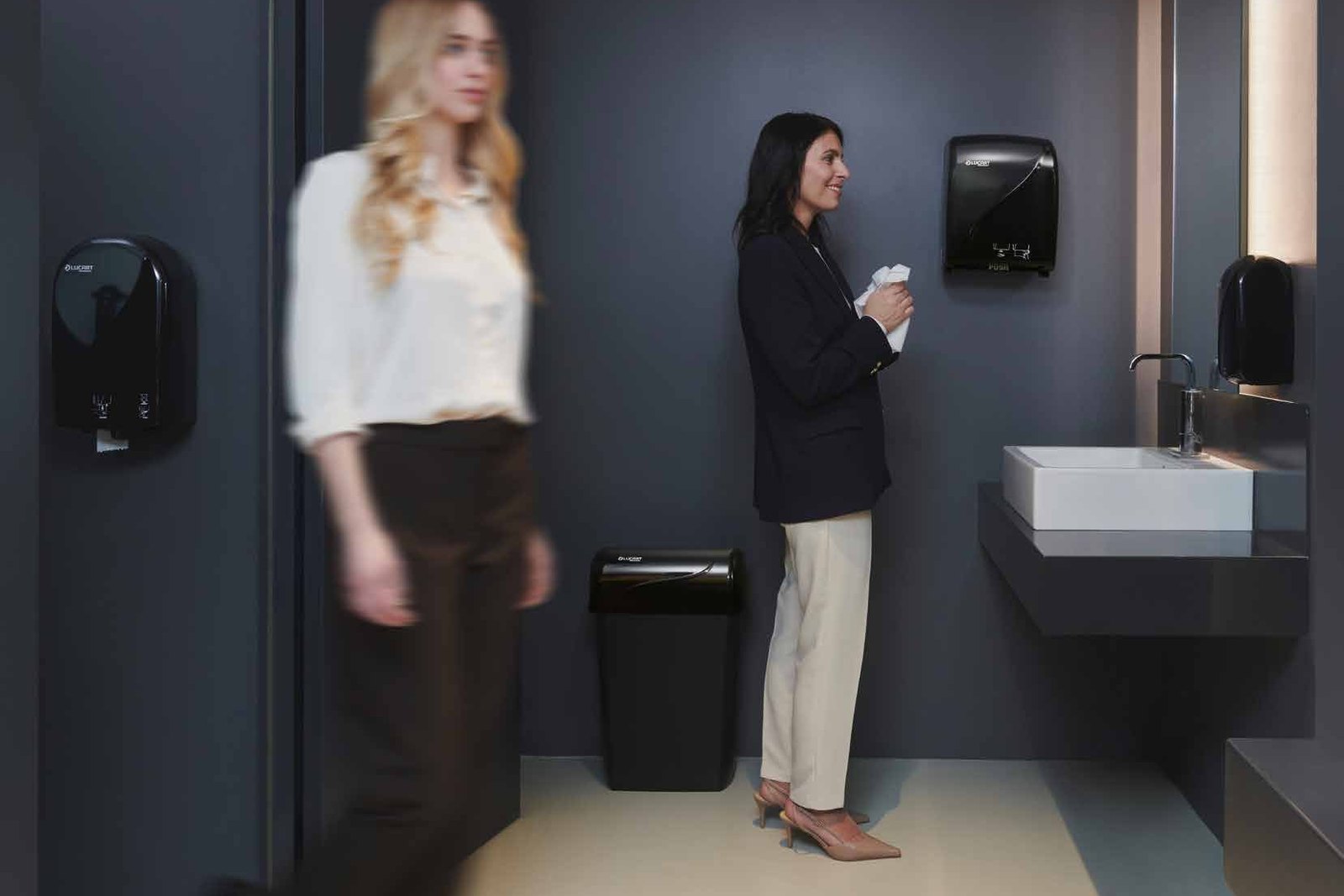
A restaurant guest does not see the kitchen, but does see the washroom. Three different holders, a roll on the cistern and soap in a supermarket bottle say more than the owner would like. The Aquarius and Identity lines make towel, toilet paper and soap dispensers in the same shape and in two colours, white and black, so the washroom looks like one piece. Rounded housings with no hidden corners wipe clean in one pass, which also shortens cleaning. How the washroom fits into the daily routine of housekeeping staff is covered in our guide to the hotel room cleaning plan, and the hand-washing rules for kitchens in the guide to HACCP kitchen hygiene.
How to switch to dispensers
- List the points of use: the number of cubicles, basins and urinals per washroom, separately for guests and for staff.
- Estimate the traffic: guests or employees per day, and when the peaks are.
- Choose one system for hand towels and one for toilet paper for the whole site.
- Add soap and a bin from the same line at every basin.
- Work out the monthly quantity using the example above and agree a regular delivery, so that stock does not depend on who remembered to order.
If you send us the number of washrooms, the approximate number of users per day and photos of your existing dispensers, we will propose a system, a refill and a monthly quantity of paper, for sites anywhere in Montenegro. The full range is in the category hygiene paper, with paper hand towels and toilet paper listed separately, and the ranges by manufacturer are on the Kimberly-Clark Professional and Lucart Professional pages. The same logic of exact dosing applies to chemicals too, as explained in our guide to professional cleaning chemicals.
Sources
- Capacities, dimensions and compatible refills: product pages for Aquarius, Scott, Hostess (Kimberly-Clark Professional) and Lucart Identity, L-One and EcoNatural on interesta.net (manufacturers’ specifications)
- World Health Organization — Hand Hygiene: Why, How & When? (drying hands with a single-use towel)
- Interesta — How much paper a hotel uses per room (how consumption is calculated)
Get our tips by e-mail
New tips, products and offers for professional hygiene, straight to your inbox.