Office info
 Storage info
In short
- A professional laundry detergent is chosen on four things: the type of linen (white, coloured, kitchen), the level of soiling, water hardness and how it is dosed (manually or automatically). The brand comes fifth.
- Industrial laundry detergent is dosed per kilogram of dry linen, not per wash. For CLAX 100 that is 1.5 to 12 ml/kg, for CLAX Plus PE 6 to 13 ml/kg, and for the CLAX Bioextra powder 8 to 24 g/kg.
- CLAX is a modular system for professional machines and automatic dosing; OMO Pro Formula is a complete detergent from a familiar brand, dosed per wash and suited to smaller properties.
- Liquid concentrate goes with a dosing system, powder and tablets with manual dosing. CLAX Tabs are the safest choice when staff have no time to measure: two tablets per load.
A hotel or laundry looking for a professional laundry detergent in Montenegro usually asks which one is best. The better question is which detergent suits our linen, our water and our machines. The same drum that gives white bed linen in one hotel leaves grey towels in another, because the water is harder, the machine is bigger or staff dose with a cup. In this guide we explain how to choose an industrial laundry detergent, how CLAX and OMO Professional differ, when concentrate, powder or tablets make sense, and how much of each product is dosed per kilogram of linen according to the manufacturer’s data.
How a professional laundry detergent differs from a household one
A household detergent is designed to wash everything with one product: small loads, mixed fabrics, unknown water. It is a compromise with plenty of filler and fragrance, and the dose is “one scoop per wash”. Laundry products for hotels and commercial laundries work the other way round:
- They are dosed per kilogram of dry linen. A 25 kg machine full of towels and the same machine half full do not get the same dose.
- The dose changes with water hardness and soiling. The range between lightly and heavily soiled linen can be up to eightfold.
- The programme is built from components. Detergent, alkaline booster, bleach and final-rinse neutraliser are dosed separately, so for kitchen cloths only the alkali is increased rather than the whole product changed.
- They come with technical and safety data sheets. For every product the pH, temperature, suitable fabrics and what must not be mixed are known.
Our full range is on the laundry chemicals in Montenegro page and in the textile care category, split into products for automatic dosing and products for manual dosing.
Four questions before you choose
1. What linen do you wash?
White cotton bed linen and towels tolerate higher alkalinity, optical brighteners and bleach. Coloured linen, uniforms, microfibre and coloured table linen need a milder detergent without bleach. Kitchen cloths, aprons and kitchen workwear carry grease and need an alkaline booster. The more clearly the groups are separated, the simpler the programme.
2. How heavily is it soiled?
Hotel bed linen is usually lightly soiled, towels medium (creams, make-up, sun oil) and restaurant textiles heavily. The manufacturer gives a separate dose for each level, so a load of bed linen and a load of kitchen cloths use different amounts of the same detergent.
3. How hard is your water?
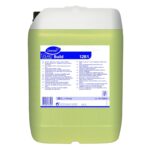
In hard water part of the detergent is used up binding calcium and magnesium, leaving less for washing. Water is commonly classed as soft (below about 8.4 °dH), medium (8.4 to 14 °dH) and hard (above 14 °dH). Some detergents work only in soft water, others in all, and the CLAX Build booster needs up to three times the dose in hard water compared with soft. Ask your local water utility or measure it with a test strip; it is a figure to know before the first order.
4. Who doses?
If the laundry has three or more machines or washes from around 300 kg a day, automatic dosing of liquid concentrates pays off. For one or two machines, manual dosing of powder, tablets or paste is enough, with a measuring cup and a wall chart. We explain the difference in detail in manual or automatic dosing in the laundry.
Concentrate, powder, tablets or paste
| Form | Examples | Dosing | When it makes sense |
|---|---|---|---|
| Liquid concentrate (20 L) | CLAX 100, CLAX Plus PE, CLAX Mild, CLAX Profi | Dosing system pumps, to the millilitre per formula | Three or more machines, several linen types, several shifts |
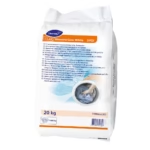
| Powder (20 kg) | CLAX Bioextra Conc White, CLAX Saturn (booster) | Measuring cup, grams per kilogram of linen | One or two machines, mainly white linen |
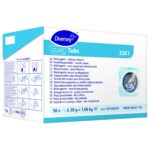
| Tablets (56 pcs) | CLAX Tabs | 2 tablets per load, 3 for heavy soiling | Restaurants, small hotels, hospital wards; no measuring or spills |
| Paste (10 L) | CLAX Pasta | 0.5 to 5 ml/kg or straight onto the stain | Greasy uniforms and table linen, pre-wash |
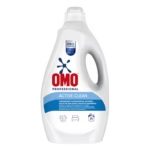
| Complete branded detergent | OMO Pro Formula Active Clean (5 L), OMO Automat White and Colour (5.4 kg) | Per wash, as instructed on the pack | Apartments, villas, smaller properties with lower-capacity machines |
CLAX or OMO Professional
Both brands belong to Diversey, but they are meant for different laundries.
CLAX is the professional range for commercial, hotel and hospital laundries. The detergent is one component, alongside boosters, bleaches and neutralisers. The dose is set in ml or g per kilogram of dry linen, separately for light, medium and heavy soiling and for soft or hard water. The advantage is precision: bed linen is washed more gently and for less time, kitchen textiles more strongly, and consumption can be calculated in advance.
OMO Pro Formula is the professional line of a familiar brand. It is a complete detergent with enzymes and bleaching agents, dosed per wash: a 5 L can of liquid OMO Active Clean gives 71 washes, and a 5.4 kg pack of OMO Automat powder 108 washes. It suits properties washing in lower-capacity machines, where staff do not weigh loads, and guests who recognise the scent of a well-known brand.
The rule we use in practice: when linen is measured in kilograms and there is a professional machine, choose CLAX; when you wash “by the machine” in a smaller property, OMO Pro Formula is the simpler choice.
Which CLAX detergent for which linen
Doses are taken from the manufacturer’s technical data published on the product pages, in millilitres or grams per kilogram of dry linen.
| Linen and conditions | Detergent | Dose per kg of dry linen | Note |
|---|---|---|---|
| White bed linen and towels, automatic dosing | CLAX 100 | 1.5–3 ml light, 3–6 ml medium, 5–12 ml heavy | Concentrate with optical brightener; with CLAX Build according to water hardness |
| White and coloured, any water hardness | CLAX Plus PE | 6–13 ml, 30–60 °C | Enzymatic, phosphate- and bleach-free; for coloureds and microfibre |
| Soft water (below 8 °dH) | CLAX Profi | 3–9 ml light, 9–15 ml medium | Complete detergent on one pump; soft or softened water only |
| Delicate and coloured, uniforms | CLAX Mild | 4–16 ml, 30–60 °C | Low alkalinity, enzymes for blood and food |
| White linen, manual dosing | CLAX Bioextra Conc White | 8–13 g light, 10–17 g medium, 14–24 g heavy; 40–60 °C | Phosphate-free powder with bleach |
| Kitchen cloths, table linen, workwear | detergent + CLAX 200 Pur-Eco or CLAX Pasta | 200 Pur-Eco 0.5–6 ml; Pasta 0.5–5 ml | Grease boosters; with the alkaline booster CLAX Build or Saturn |
Every programme ends with a neutralising rinse, for example CLAX Neutrapur (1.5–4 ml/kg), which lowers the pH of the linen and protects the guest’s skin. Neutralisers and softeners are grouped in the fabric softeners and neutralisers category.
How much detergent a hotel uses: a worked example
Take a 120-room hotel with average occupancy of 70 %, that is 84 occupied rooms a day. If around 3 kg of linen (bed linen and towels) is washed per occupied room per day, that is about 250 kg a day, or about 7,560 kg a month. For that quantity, at medium soiling and the manufacturer’s doses, monthly consumption looks like this:
| Product | Dose per kg (medium soiling) | Monthly for 7,560 kg | Cans or bags |
|---|---|---|---|
| CLAX 100 (liquid concentrate) | 3–6 ml | 23–45 L | 2–3 cans of 20 L |
| CLAX Plus PE (liquid) | 6–13 ml | 45–98 L | 3–5 cans of 20 L |
| CLAX Bioextra Conc White (powder) | 10–17 g | 76–129 kg | 4–7 bags of 20 kg |
| CLAX Neutrapur (final rinse) | 1.5–4 ml | 11–30 L | 1–2 cans of 20 L |
An example, not an average: the amount of linen per room depends on whether bed linen and towels are changed daily. Boosters and bleaches are not included; their dose depends on water hardness and the programme.
The table shows two things. First, CLAX 100 concentrate is used in a smaller volume than the others, but it is combined with a booster, so compare whole programmes, not cans. Second, the range within one product is twofold. If staff dose at the top end “just in case”, the hotel uses twice as much detergent and the linen is no cleaner: the excess stays in the fibres, towels turn stiff and bed linen greys faster. How to plan other consumables per room is shown in how much paper a hotel uses per room.
Before you change detergent, weigh one machine load and measure the water hardness. Most problems with grey or stiff linen come from a 20 kg machine carrying 14 kg while the dose is set for 20, or from a soft-water detergent used in hard water. Once you know the kilograms per load and the °dH, the dose is read from a chart rather than guessed.
Five mistakes when choosing a detergent
- Choosing by the price of the can. Compare the cost per kilogram of washed linen, not the price per litre. A concentrate dosed at 3 ml/kg and a more dilute detergent at 10 ml/kg are not the same product.
- One detergent for everything. White bed linen and kitchen cloths do not need the same chemistry. A shared base detergent is fine, but the difference is made with boosters and bleach.
- A soft-water detergent in hard water. CLAX Profi is made for water below 8 °dH. In hard water choose a detergent for all hardness levels and add a booster or sequestrant (CLAX Renova).
- Powder in an automatic system. Dosing pumps work with liquids; powder and tablets are for manual dosing.
- Skipping the final rinse. Linen that leaves the machine alkaline irritates skin and wears out faster. The neutraliser is the cheapest component of the programme.
How to switch to a professional laundry detergent
For a quotation we need five things: the number and capacity of your machines, kilograms of linen per day by type (bed linen, towels, restaurant textiles, uniforms), water hardness, the temperatures you wash at and whether you dose manually or have a dosing system. On that basis we propose a programme with a dose per kilogram and monthly consumption, and for automatic dosing we install and programme the dosing equipment on site anywhere in Montenegro. How the same logic of exact dosing applies to cleaning chemicals for the building is explained in professional cleaning chemicals: cost per litre, and for hotel housekeeping in hotel room cleaning plan.
Sources
- Doses and technical data: product pages for CLAX 100, CLAX Plus PE, CLAX Profi, CLAX Mild, CLAX Bioextra Conc White, CLAX Tabs, CLAX Pasta, CLAX 200 Pur-Eco, CLAX Build, CLAX Neutrapur and OMO Pro Formula on interesta.net (Diversey technical data sheets)
- Diversey Pro Formula — OMO Professional (washes per pack)
- German Detergents Act (WRMG, § 9) — water hardness ranges: soft, medium, hard
Get our tips by e-mail
New tips, products and offers for professional hygiene, straight to your inbox.