Office info
 Storage info

In brief
- Most of the energy a washing machine uses goes into heating water. A main wash at 30 °C instead of 60 °C needs about two thirds less heating energy, and a wash at 40 °C about 45% less.
- A lower temperature needs different chemistry, not just a different programme: the enzymatic detergent CLAX Cool, the bleach booster CLAX Crisp and the bleach CLAX Bright Bleach, which works from 30 °C.
- For a 120-room hotel the difference is, by our calculation, about 880 kWh a month at 40 °C and about 1,320 kWh a month at 30 °C, for heating the main wash water alone.
- Cold washing is for lightly soiled bed and bath linen. Kitchen cloths, heavily greasy items and linen that must be disinfected are still washed at 60 °C or above.
When the electricity or fuel bill for the laundry goes up, the tumble dryer and the ironer are the first suspects. The washing machine is rarely questioned, although every programme at 60 or 70 °C heats several litres of water for each kilogram of linen. Low-temperature laundry is now a proven process for hotels in Montenegro and elsewhere, provided the programme and the chemicals are changed together. In this guide we calculate how much energy is really saved, explain what CLAX Cool and CLAX Crisp do, and show where cold washing reaches its limits.
Where the energy goes in a wash
Laundry chemicals and energy savings are linked by one number: heating one litre of water by one degree takes 1.163 Wh. A professional washer uses roughly 4 to 5 litres of water per kilogram of dry linen in the main wash. If mains water comes in at 15 °C and the main wash holds 5 litres per kilogram, the calculation per kilogram of linen looks like this:
| Main wash temperature | Water heating per kg of linen | Compared with 60 °C |
|---|---|---|
| 70 °C | about 0.32 kWh | +22% |
| 60 °C | about 0.26 kWh | — |
| 40 °C | about 0.15 kWh | −44% |
| 30 °C | about 0.09 kWh | −67% |
The calculation covers only heating the main wash water (5 L/kg, inlet water at 15 °C). It leaves out heating the drum and the linen itself, heat losses and any heated prewash, so the machine’s real consumption is somewhat higher. In summer the inlet water is warmer and the saving is smaller; in winter it is larger. Drying and ironing use the same energy whatever the wash temperature.
Why you cannot simply turn the temperature down
The wash result depends on four factors: temperature, chemistry, time and the mechanical action of the drum. If one is reduced, the others have to make up for it. An ordinary detergent and a high-temperature bleach work less well at 30 or 40 °C: skin oils and creams stay in the fibre, the oxygen bleach is not activated, and after a few weeks the linen starts to turn grey and yellow. We described the causes of greying and yellowing in the guide on laundry bleach and stain removers for hotels.
That is why low temperatures call for products made for them: enzymes that break down protein, fat and starch in lukewarm water, a bleach that is active from 30 °C, and agents that keep soil suspended in the wash liquor so that it does not settle back on the fibre.
Two levels: washing at 40 °C and washing at 30 °C
Diversey has two low-temperature programmes for hotel laundries. The figures in the table come from the manufacturer’s technical data sheets published on the product pages; the doses apply to lightly soiled bed and bath linen.
| Conventional wash | Low temperature (Clax Advanced) | Cold wash (Clax Polar) | |
|---|---|---|---|
| Main wash | 60–70 °C | 40 °C | about 30 °C |
| Detergent | alkaline detergent, with a booster if needed | CLAX Plus PE, 6–13 ml/kg | CLAX Cool, about 10 ml/kg |
| Bleach | CLAX Personril, 8–12 ml/kg | CLAX Bright Bleach | CLAX Bright Bleach, 4–5 ml/kg |
| Boosters | according to water hardness and soiling | if needed | CLAX Crisp, 4–5 ml/kg; CLAX 200 Pur-Eco, 0.5–2 ml/kg |
| Dosing | automatic or manual | automatic | automatic only |
| For which linen | everything, including heavily soiled items and linen that is disinfected | bed and bath linen, white and colour-fast | lightly soiled bed and bath linen |
Moving to 40 °C is the smaller step: the detergent many laundries already use stays, and the bleach changes. Moving to 30 °C is a separate system of four products that work together, and the manufacturer’s data sheets list them only in that combination.
CLAX Cool and CLAX Crisp: what each one does


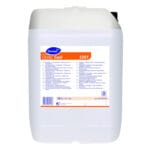
CLAX Cool is a liquid enzymatic main wash detergent without bleach. It is mild and low in alkalinity (pH of the concentrate about 7.4), so it suits both white and coloured cotton and polycotton. It contains agents that bind water hardness and prevent greying and dye transfer, and its enzymes are particularly effective on protein stains such as blood and food residues. It works in medium-hard and hard water. The recommended dose for lightly soiled bed and bath linen is about 10 ml per kilogram of linen.
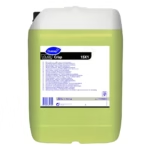
CLAX Crisp is not a detergent but a booster for oxygen bleach. It is added alongside the bleach so that residual stains are removed in cold water too, and it contains anti-greying agents that keep soil particles suspended in the liquor. The dose is 4–5 ml per kilogram of dry linen, by automatic dosing only.
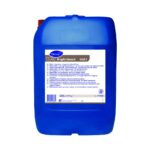
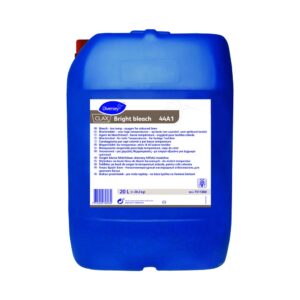
CLAX Bright Bleach is an oxygen bleach based on PAP acid. With the detergent CLAX Plus it works at 40 °C, and in combination with Cool, Crisp and 200 Pur-Eco from 30 °C. It can be used on all fabrics except wool, including colour-fast items. The manufacturer requires the pH of the wash liquor to be between 9.2 and 9.5 before the bleach is dosed, which is the main reason this system is not dosed by hand.
CLAX 200 Pur-Eco is a multi-enzyme booster for fatty and oily soil, carrying the Nordic Swan label. In a cold wash it does the job hot water would otherwise do: it removes skin oils, creams and sun lotion.
Do not switch the whole laundry at once. Start with one machine and one type of linen, ideally bed linen. For a month, keep three figures: how many items come back for rewashing, how the whiteness compares with linen from the old programme, and how long the cycle takes. If the number of rewashed items does not rise, move the programme on to towels and then to the other machines.
How much you save: a 120-room hotel
We use the same example as in the guide on professional laundry detergent: a hotel with 120 rooms, 70% occupancy and about 3 kg of linen per occupied room per day, roughly 7,560 kg a month. The assumption is that all of it is washed on the same programme.
| Main wash | Water heating per month | Saving per month | Saving per year |
|---|---|---|---|
| 60 °C | about 1,980 kWh | — | — |
| 40 °C | about 1,100 kWh | about 880 kWh | about 10,500 kWh |
| 30 °C | about 660 kWh | about 1,320 kWh | about 15,800 kWh |
An example, not a measurement. To get the value in euros, multiply the kilowatt-hours by the price on your own bill. If your machines heat water with steam or with hot water from a boiler, convert the saving into fuel, allowing for boiler efficiency.
For the same programmes the manufacturer also quotes savings that this calculation does not cover. For Clax Polar, with one rinse instead of several, Solenis quotes up to 65% less energy in laundries heated by electricity only, up to 50% less water, up to 23% shorter wash time and up to 30% longer linen life. For Clax Advanced at 40 °C the brochure quotes up to 35% less water, up to 40% less steam, up to 15% less electricity, up to 16% shorter wash time and up to 30% longer linen life. These are the best measured results from six large hotels in each case, not a guarantee for every laundry, but our water-heating calculation is consistent with them.
Longer linen life is often worth more than the electricity. High temperature and strong alkali wear down cotton fibre with every wash. Linen that survives more wash cycles means a smaller annual textile purchase.
How much product a cold wash uses
For the same 7,560 kg a month, at the data-sheet doses for lightly soiled bed and bath linen:
| Product | Dose per kg | Per month for 7,560 kg |
|---|---|---|
| CLAX Cool | about 10 ml | about 76 L |
| CLAX Bright Bleach | 4–5 ml | 30–38 L |
| CLAX Crisp | 4–5 ml | 30–38 L |
| CLAX 200 Pur-Eco | 0.5–2 ml | 4–15 L |
Cold washing does not mean less product. The four products together come to 19 to 22 ml per kilogram of linen, which is similar to or slightly more than a conventional programme. The saving comes from energy, water, time and textiles, and the exact dose is set on the dosing unit to suit the water and linen at your site.
When cold washing is not the answer
- Linen that must be disinfected. Linen from healthcare facilities and care homes, and linen used by guests with an infection, is washed by a disinfecting process at 60 °C or above, with a product such as CLAX Personril. Solenis states that Clax Polar complies with EN 14065 and is active against enveloped viruses under EN 14476, but that applies to hospitality hygiene, not to hospital linen.
- Kitchen cloths, aprons and mops. Heavy grease and food residues need a higher temperature and an alkaline booster.
- Heavily soiled or neglected linen. Linen that has already turned grey or yellow should first be recovered at a higher temperature and only then maintained at a low one.
- Wool. CLAX Bright Bleach is not used on woollen items.
- A laundry without automatic dosing. Four products in the right order, with pH control, cannot be dosed reliably by hand. We explained the difference in the guide on manual or automatic dosing in the laundry.
At low temperatures the hygiene of the machine itself matters more. Once a week, run one programme at 60 °C or above with an oxygen bleach, so that biofilm and odour do not build up in the drum and hoses.
How to move to low-temperature washing
- Measure where you are now: kilograms of linen by type, programme temperatures and times, electricity or fuel consumption, rewash rate.
- Check the water. The manufacturer recommends softened water for the best result. Measure hardness with a test strip or ask your local water utility.
- Sort the linen: whites from coloureds, cotton from polycotton, lightly soiled from heavily soiled. Light and medium soiling goes on the low-temperature programme.
- Programme the machines and the dosing unit together. Temperature, time, number of rinses and dosing sequence make up one programme.
- Keep the final rinse with a neutraliser, for example CLAX Neutrapur, or CLAX Soft 2in1 for towels. The other products are in the category fabric softeners and laundry neutralisers.
- Track the result for a month before moving the programme to the other machines.
To propose a programme we need the number and capacity of your machines, how they are heated (electricity, steam or hot water), kilograms of linen by type, water hardness and the temperatures you wash at now. On that basis we propose a programme and doses, and we install and programme the dosing equipment on site, anywhere in Montenegro. Products for dosing units are in the category laundry chemicals for automatic dosing, and for smaller laundries there are detergents for manual dosing. The full range is in the category professional laundry chemicals and on our page laundry chemicals in Montenegro. The same logic of exact dosing applies to the other chemicals on site, as we explain in the guide on professional cleaning chemicals.
Sources
- Doses and technical data: product pages for CLAX Cool, Crisp, Bright Bleach, 200 Pur-Eco, Plus PE and Personril on interesta.net (Diversey technical data sheets, 2022)
- Solenis — Clax Polar, cold washing programme for hospitality (savings measured in six European hotels, EN 14065, EN 14476)
- Solenis / Diversey — Clax Advanced, low-temperature laundry programme (brochure 56885-LIT, 2018; verified by Hohenstein Laboratories)
- Energy calculation: specific heat of water 4.186 kJ/(kg·K), i.e. 1.163 Wh per litre per degree; assumptions stated in the text
Get our tips by e-mail
New tips, products and offers for professional hygiene, straight to your inbox.