 Office info
 Storage info
In brief
- A neutraliser and a fabric softener do two different jobs. The neutraliser removes the alkaline residue left by the detergent and lowers the pH of the linen; the softener lubricates the fibres and gives softness, scent and less static.
- The target can be measured: linen pH of about 6.5, or a pH of 6.0 to 6.5 in the last water leaving the machine or the press. CLAX Neutrapur is dosed at 1.5–4 ml per kilogram of linen to reach it.
- Bed linen and table linen need a neutraliser. Towels and terry suit a 2-in-1 product, CLAX Soft 2in1. Coccolino Professional is a softener for smaller laundries that dose by hand.
- A softener does not replace a neutraliser, and too much softener leaves towels feeling greasy. Microfibre cloths and mops are washed without softener.
When a guest complains that the bed linen feels rough or the towel is scratchy, the first thought is fabric softener. When bed linen turns yellow after a few months, the first thought is bleach. In both cases the cause can be the same: the linen leaves the machine alkaline, with no proper final treatment. A hotel in Montenegro looking for a professional fabric softener should therefore first decide what it actually needs: a neutraliser, a softener, or both in one product. All three are in our range of fabric softeners and laundry neutralisers. This guide explains the difference, gives the target pH and the data-sheet doses, and shows what goes on which linen.
What stays on the linen after washing
Detergents and bleaches work in an alkaline wash liquor. A one per cent solution of the detergent CLAX Profi has a pH of about 12.4, and the bleach CLAX Bright Bleach needs the liquor to be between pH 9.2 and 9.5 before it is dosed. On the pH scale 7 is neutral and each unit is a tenfold difference, so pH 10 is a thousand times more alkaline than neutral water.
Rinsing removes most of the alkali, but not all of it. Some stays in the fibre, and the water itself brings alkalinity: the manufacturer’s data sheet says the neutraliser dose depends on the wash programme and on the alkalinity of the fresh water absorbed by the fabric. We described how to choose the detergent and the main wash dose in the guide on professional laundry detergent.
Alkaline residue shows in three ways:
- Yellowing. Diversey states in its data sheet that neutralising residual alkali prevents yellowing of the fabric. Linen that yellows is written off sooner.
- Guest skin. Healthy skin is slightly acidic, and bed linen and towels are in contact with it for hours. Linen that leaves the laundry alkaline can irritate the skin.
- Feel. A hard towel can be the result of alkaline residue and excess chemicals in the fibre, not only of too little softener.
The neutraliser: what it does and what the target is
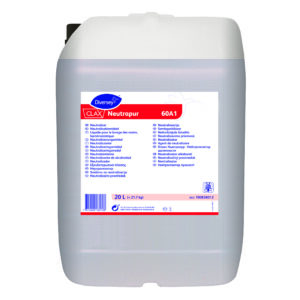
A neutraliser, or laundry sour, is an acidic product dosed in the last rinse. It does not wash; it cancels out the alkali left in the water and on the fabric. CLAX Neutrapur is based on a strong organic acid, leaves no odour on the linen and can be used in every wash programme and on all types of textile. It is dosed automatically at 1.5 to 4 ml per kilogram of linen, and the target given by the manufacturer is a linen pH of about 6.5.
Where the water contains iron, CLAX Rust can take over the same role: at 2–3 g per kilogram of dry linen it prevents rust stains and also neutralises residual alkalinity. We covered yellowing and iron stains in the guide on laundry bleach and stain removers for hotels.
The softener: what it does and what it does not
A fabric softener contains cationic ingredients that attach to the fibre and lubricate it. During drying the fibres interlock less, static does not build up on synthetics, and the linen is easier to iron and carries a scent. A softener does not wash and is not designed to control the pH of the linen: the manufacturer gives a target pH for neutralisers, but not for softeners.
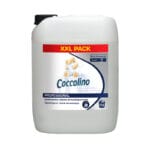
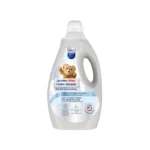
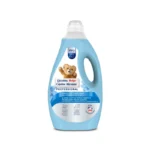
Coccolino Professional is the softener in the Pro Formula range, mainly for sites that dose by hand. Coccolino Professional Pure (10 L) and Coccolino Pro Formula Sensitive (5 L) have a hypoallergenic, dermatologically tested formula, while Coccolino Pro Formula Fresh (5 L) has a fresh scent that, according to the manufacturer, lasts up to three times longer than with dilute products. Each 5 L concentrate is enough for up to 200 washes.
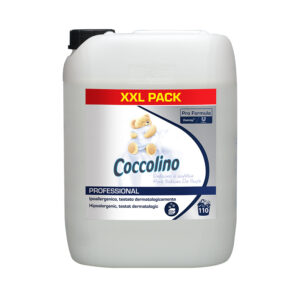
Neutraliser, 2-in-1 or softener: a comparison
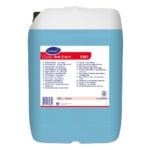
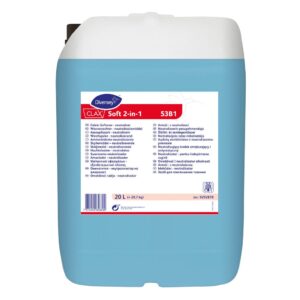
CLAX Soft 2in1 is an alkalinity neutraliser with softening properties: citric acid neutralises the alkali, and quaternary ammonium salts soften the fibre. The table uses the product pages and the manufacturers’ data sheets.
| Neutraliser | Neutraliser with softener (2-in-1) | Softener | |
|---|---|---|---|
| Product | CLAX Neutrapur | CLAX Soft 2in1 | Coccolino Professional Pure, Sensitive and Fresh |
| Based on | a strong organic acid | organic acids (citric) and quaternary ammonium salts | cationic surfactants and perfume |
| What it does | neutralises residual alkalinity, leaves no odour | neutralises alkalinity, softens, reduces static, makes ironing easier, leaves a pleasant scent | softens, reduces creasing and static, makes ironing easier, leaves a scent |
| Target given by the manufacturer | linen pH of about 6.5 | pH 6.0–6.5 in the last water from the machine or the press | no target pH given |
| Dose | 1.5–4 ml per kg of linen | according to the programme and water alkalinity; the 2025 data sheet gives 2.8–4.2 g per kg of dry linen | per wash; a 5 L bottle for up to 200 washes |
| Dosing | automatic, in the last rinse | automatic, in the last rinse | by hand or through a dosing unit, in the last rinse |
| For which linen | all linen, above all bed and table linen | towels, terry and synthetics | smaller laundries; Pure and Sensitive for sensitive skin |
For some classifications of linen the manufacturer allows other pH guidelines, so the target value is confirmed when the programme is set up. Doses apply to optimal conditions.
What goes on which linen
| Linen | Final treatment | Why |
|---|---|---|
| Bed linen | CLAX Neutrapur | Neutralising prevents yellowing; no added scent |
| Towels, terry, bathrobes | CLAX Soft 2in1 | Softening is most noticeable on bulked, textured fabrics |
| Tablecloths and napkins | CLAX Neutrapur | They are finished on the ironer; they do not need the softness of terry |
| Synthetics and polyester blends | CLAX Soft 2in1 | Prevents static building up on synthetic fibres |
| Linen at a site with iron in the water | CLAX Rust | Prevents rust stains and neutralises alkalinity |
| Small laundry, apartments, manual dosing | Coccolino Professional | Dosed per wash, with no dosing unit |
| Sites where sensitive skin is a priority | Coccolino Professional Pure or Sensitive | Hypoallergenic, dermatologically tested formula |
| Microfibre cloths and mops | no softener | Softener clogs microfibre and reduces cleaning performance |
The last row applies to all microfibre products, for example TASKI MicroQuick cloths. In manual dosing there is no separate neutraliser, because CLAX Neutrapur and Soft 2in1 are made for dosing equipment, so the exact detergent dose and a complete rinse matter even more.
Do not set the neutraliser by feel. Once a month, for each programme separately, take a sample of the last water leaving the machine or the press and measure its pH with a test strip or a pH meter. The target is 6.0 to 6.5. If the value is above the target, raise the dose in small steps; if it is below 6, reduce it. Measure the mains water as well and keep the results on one sheet.
How much is used: a 120-room hotel
We use the same example as in the earlier guides: a hotel with 120 rooms, 70% occupancy and about 3 kg of linen per occupied room per day, roughly 7,560 kg a month. We assume that 60% is bed linen and 40% is towels and terry.
| Programme | Linen per month | Dose | Consumption per month |
|---|---|---|---|
| All linen with CLAX Neutrapur | 7,560 kg | 1.5–4 ml/kg | 11–30 L |
| Bed linen with CLAX Neutrapur | about 4,540 kg | 1.5–4 ml/kg | 7–18 L |
| Towels with CLAX Soft 2in1 | about 3,020 kg | 2.8–4.2 g/kg | 8.5–12.7 kg, or 8–12 L |
An example, not a measurement. The 60 : 40 split is an assumption; use your own kilograms. Grams are converted to litres using a density of 1.03.
The final treatment is the smallest item in the programme. Neutrapur is dosed at 1.5 to 4 ml per kilogram, while a main wash detergent such as CLAX Plus PE is dosed at 6 to 13 ml per kilogram. For the whole hotel in the example that is at most one and a half 20 L canisters of Neutrapur a month.
A 5 L bottle of Coccolino Pro Formula is enough for up to 200 washes, which is about 25 ml per wash. A guesthouse that runs four washes a day uses about 3 L a month, so one bottle lasts about 50 days.
Guest skin and linen life
A guest does not see pH but feels the consequences: a rough towel or harsh bed linen. Neutralised linen at about pH 6.5 is closer to the natural acidity of skin than linen with alkaline residue, and a hypoallergenic softener is extra reassurance where guests with sensitive skin stay.
The textile gains too. Bed linen that does not yellow stays in use longer, and the fibres of a towel treated with softener interlock less during drying. For the Clax Xcellence programme, in which Soft 2in1 is the finishing product, Diversey lists softness of the linen, a softener that is activated by moisture when the guest uses the fabric, longer fabric life and a programme with two rinses. We showed how wash temperature affects the fibre and the energy bill in the guide on low-temperature laundry for hotels.
The most common mistakes
- Softener instead of a neutraliser. The linen smells nice and feels soft, but the alkaline residue stays and the bed linen yellows over time.
- Too much softener on towels. The excess stays in the fibre and the towel feels greasy.
- The same dose for every water supply. The neutraliser dose depends on the alkalinity of the water, so a programme cannot simply be copied from another site.
- Dosing without measuring. The target is a pH range, not as much acid as possible.
- An acidic product and chlorine in the same step. Neutralisers are acidic. With chlorine bleach they release toxic chlorine gas, so the two are never dosed together or poured into the same container.
- A shortened rinse. A programme without a final rinse with neutraliser saves a few minutes and costs you linen.
- Softener on microfibre. Cloths and mops lose their absorbency and cleaning power.
Most of these mistakes are solved by a dosing unit that adds the same amount at the right moment in every cycle, as we explain in the guide on manual or automatic dosing in the laundry.
How to choose
- Measure the pH of the last water on the programmes for bed linen and for towels.
- Separate the programmes. Bed and table linen finish with a neutraliser, towels and terry with a 2-in-1 product.
- Check the water. Hardness, alkalinity and iron decide the dose and the choice of product.
- Set the dose and measure again. After every change of detergent or programme the measurement is repeated.
To propose a final treatment we need the number and capacity of your machines, kilograms of linen by type, water hardness and whether there is iron in the water. On that basis we propose a product and a dose, and we install and programme the dosing equipment on site, anywhere in Montenegro. Neutralisers and 2-in-1 products are in the category laundry chemicals for automatic dosing, Coccolino softeners are among the products for manual dosing, and the full range is in the category professional laundry chemicals and on our page laundry chemicals in Montenegro.
Sources
- Doses and technical data: product pages for CLAX Neutrapur, CLAX Soft 2in1, CLAX Rust, CLAX Profi, CLAX Bright Bleach and Coccolino Professional on interesta.net (Diversey technical data sheets: Clax Neutrapur 60A1, 2024; Clax Soft 2-in-1 53B1)
- Diversey — Clax Soft 2-in-1 53B1, product information sheet (rev. 05/02/2025, K02814): pH of the last water 6.0–6.5; dose 2.8–4.2 g per kg of dry linen
- Diversey — Clax Xcellence brochure, Montenegro edition (softness of linen, fabric life, two rinses)
- Pro Formula (Unilever Professional / Diversey) — Coccolino Professional Sensitive and Fresh 5 L: hypoallergenic, dermatologically tested formula; up to 200 washes from one bottle
- Calculation: 120 rooms × 70% × 3 kg × 30 days = 7,560 kg a month; assumptions stated in the text
Get our tips by e-mail
New tips, products and offers for professional hygiene, straight to your inbox.